Gyochon Hanok Village and Woljeonggyo Bridge
A free hanok village with the Choi family house and a Confucian school, next to a Silla bridge lit at night until 22:00
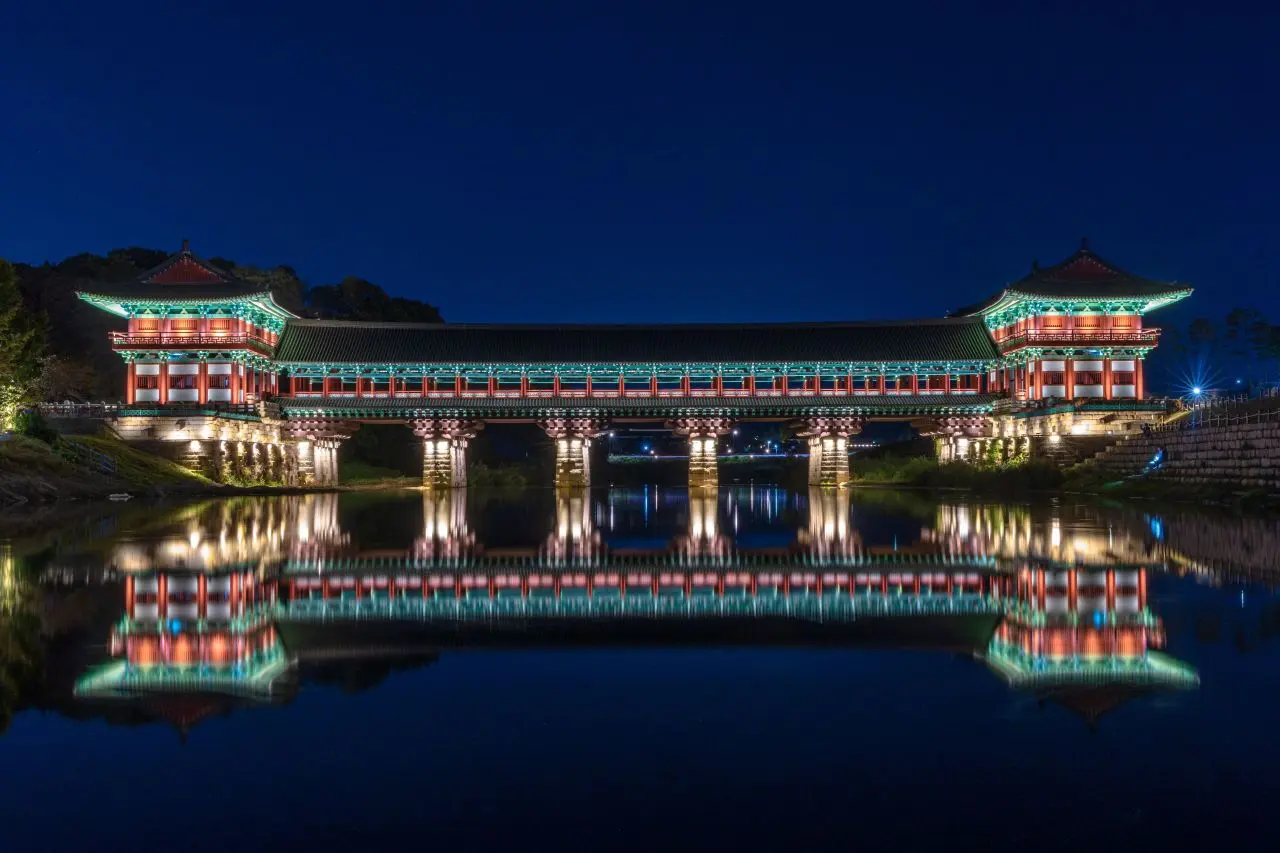
Intro
Gyochon is a small village of hanok (traditional houses) in the center of Gyeongju, on the site where the Silla kingdom founded its national academy in 682. The academy became a local school under the Goryeo and Joseon dynasties, and the village took its name from it: Gyochon means school village. Two places anchor it: the house of the Choi family, rich landowners for 12 generations, and Gyeongju Hyanggyo, a Confucian school still in use. Woljeonggyo, a covered wooden bridge rebuilt on the Silla site, crosses the stream at the edge of the village.
Gyochon is worth a stop on any day in central Gyeongju. The village is free and open at all times, it is about 20 minutes on foot from Cheomseongdae through Gyerim Forest, and Woljeonggyo, lit at night and open until 22:00, is one of the free night views of the city. The tomb park, Cheomseongdae and Hwangnidan-gil to the north are covered on Daereungwon and Hwangnidan-gil.
Two to three hours in Gyochon and Woljeonggyo
Recent Korean visitors’ posts and the city’s own night walk course follow the same order: tombs and observatory in the late afternoon, Gyochon before the houses close, Woljeonggyo as the light goes, then Donggung Palace after dark.
- Mid to late afternoon: start at Daereungwon and Cheomseongdae, then walk through Gyerim Forest (about 5 minutes from Cheomseongdae) toward the village.
- Gyochon: see the Choi family house before it closes at 17:00 and the courtyards of Gyeongju Hyanggyo (until 18:00). One recent visitor walked round the village in about 30 minutes; allow an hour or two with the two houses.
- Early dinner: bean sprout bibimbap at Yangji Sikdang (last order 19:00, closed Wednesdays) or bibimbap at Gyochon Sambaengnyeonjip (dinner from 17:00).
- Woljeonggyo at dusk: walk down to the stream bank and the stepping stones as the lights come on.
- Donggung Palace and Wolji Pond: about 30 minutes on foot from Woljeonggyo by the city’s figure, or take a Woljeong bus. Last entry is 21:30; see Donggung Palace and Wolji Pond.
Gyochon Village
The Choi family house belonged to the head family of the Choi clan of Gyeongju, said to have been built around 1700, though the date is not certain. The city tourism site says the family cut the ground for the house three ja (a traditional unit of length) lower than the neighboring Hyanggyo so as not to stand above the school. It traces the family from Choi Jin-rip, the first generation, to Choi Jun, the 12th, an independence activist, and says they are known for house rules such as not holding any government post above the jinsa degree and not amassing wealth beyond 10,000 seok (sacks) of rice. The men’s quarters and a separate wing burned in 1970 and only their sites remain; the women’s quarters around a courtyard, the gate building, storehouse and family shrine are still standing. Entry is free. The Korea Tourism Organization lists the hours as 9:30 to 17:30 and Naver Place as 9:30 to 17:00; plan on 17:00. It is closed on the last Monday of each month.
Gyeongju Hyanggyo stands on the site of the Silla academy. It was rebuilt in 1492 following the layout of Seonggyungwan, the national academy, and again after the Imjin War (the Japanese invasions): the shrine halls in 1600 and the lecture hall in 1614. The shrine area is at the front and the teaching area (Myeongnyundang and the dormitories) behind. It is open 9:00 to 18:00 every day and is free. Confucian rites are held here in spring and autumn; the dates have not been confirmed.
Gyodong beopju is a glutinous rice liquor known as the Choi family’s house wine, sold at a shop at the same address as the Choi family house (Monday to Saturday, 9:30 to 18:00). One recent visitor paid 37,500 won for a bottle in November 2026, and was told on site that gift sets can be sent by courier free of charge but single bottles are hard to send.
Recent Korean visitors’ posts show many people walking round the village and across Woljeonggyo in rented hanbok (traditional clothes).
Woljeonggyo Bridge
The Samguk Sagi, the history of the Three Kingdoms, records that in 760 two bridges, Woljeonggyo and Chunyanggyo, were built over the stream south of the royal palace. Woljeonggyo was lost in the Joseon period. After about ten years of excavation and study, the bridge was rebuilt in 2013 and the gate pavilions at each end were finished in April 2018; the Korea Tourism Organization calls it the largest wooden bridge in Korea. The city tourism site links it to the story of the monk Wonhyo and Princess Yoseok, and to its role as the gate between the Silla palace at Wolseong and the south.
You can walk through the covered bridge from 9:00 to 22:00, free. The 2nd floor of the gate pavilion has an exhibition on the restoration, with a video and excavated objects, open from 10:00. There are toilets.
At night: the bridge is lit after dark. No fixed switch-on time is published; recent visitors say the lights come on around sunset and stay on until 22:00, and one gave about 17:40 to 18:00 in late October. The classic photograph is from the stream bank or the stepping stones across the Namcheon in front of the bridge, with the lights reflected in the water. Whether the stepping stones can be crossed after heavy rain has not been confirmed; look before you step on.
Gyerim and Cheomseongdae on foot
Gyerim Forest, between Cheomseongdae and the Wolseong palace site, is a wood of old willows and zelkovas where the founder of the Gyeongju Kim clan, Kim Alji, is said to have been found in a golden chest when a rooster crowed. It is free and open at all times, and in spring canola flowers line the path toward Wolseong. The city’s night walk course gives about 350 m (5 minutes) from Cheomseongdae to Gyerim and about 1 km (15 minutes) from Gyerim to Woljeonggyo, passing Gyochon on the way. Cheomseongdae itself is open until 22:00 (21:00 from November to February); see Daereungwon and Hwangnidan-gil.
Dining
The village restaurants serve Gyeongju’s usual dishes in hanok settings: bibimbap, yukhoe (seasoned raw beef) and yukhoe mulhoe (a cold soup with raw beef), and pancakes. Most close for a break in the afternoon, and several are closed on Wednesdays, so check each card.
- A cheap local lunch: Yangji Sikdang has two dishes, bean sprout bibimbap (10,000 won) and pajeon (13,000 won).
- Bibimbap in a hanok: Gyochon Sambaengnyeonjip, from 15,000 won, with a vegetarian mushroom bowl at the same price. It takes Naver Booking.
- Crab and beef: Jinsuseongchan for soy-marinated crab (29,000 won) and yukhoe bibimbap (15,000 won).
- A course meal: Yoseokgung 1779 serves Choi family courses at 69,000 and 120,000 won; it takes reservations by phone or Naver TalkTalk and is closed on Tuesdays.
- Gimbap to carry: Gyori Gimbap’s main shop, about 1 km south near the Oreung tombs, sells boxes of 2 rolls for 13,000 won from 8:30 (closed Wednesdays). It is on the bus route to Namsan.
Menus in the restaurants’ photos on Naver are mostly in Korean; English menus have not been confirmed at any of them.
When to go
The village and the bridge are open every day. Come in the afternoon to see the Choi family house before 17:00, and stay for Woljeonggyo after dark. In winter the sun sets close to the house’s closing time, so see the village first and the bridge afterwards.
- Autumn (late October to November): recent visitors’ posts show the ginkgo trees around Woljeonggyo and Gyochon turning yellow, often combined with the flower fields at Cheomseongdae.
- Spring: canola flowers along the path from Gyerim toward Wolseong, according to the Korea Tourism Organization.
- September: the Gyeongju Heritage Night festival uses Woljeonggyo, Gyochon, Cheomseongdae and the old town wall. In 2026 it ran from September 18 to 20, 18:00 to 23:00, mostly free; the 2027 dates have not been announced.
Getting there
- On foot: from Cheomseongdae through Gyerim Forest, about 15 to 20 minutes to Woljeonggyo by the city’s figures. From Hwangnidan-gil, walk south past Cheomseongdae.
- Woljeong circular buses: three city bus routes, Woljeong 1, 2 and 3, are the only buses that stop at Gyochon Hanok Village and Woljeonggyo. All start at the Hwangnidan-gil public parking lot. Woljeong 1 and 3 reach Gyochon after two stops; Woljeong 2 runs first to the bus terminal and comes round to Gyochon via Donggung Palace and the national museum. Times are in Hours & Fees above.
- From Gyeongju Station (KTX): take bus 50, 51 or 70 to the bus terminal, then take Woljeong 2. Details are in How to Get from Seoul to Gyeongju.
- From Namsan: buses 500 and 505 to 508 run from Samneung and stop near Gyori Gimbap at the Tamni Village and Oreung stops, about 1 km south of the village; they do not stop at Gyochon itself.
City bus fares are 1,500 won, or 1,450 won with a transit card.
Practical information
- Parking: the Korea Tourism Organization lists parking at Gyochon, and recent visitors report a free public parking lot at Woljeonggyo.
- Inquiries: Gyeongju City tourism department, +82-54-779-6830 to 6834.
- Signs: photos of the Choi family house, Hyanggyo and Woljeonggyo show information boards in Korean and English.
Common questions
- Is Gyochon Village free? Yes. The village, the Choi family house, Hyanggyo and Woljeonggyo are all free.
- What time is Woljeonggyo lit up? From around sunset until 22:00, by recent visitors’ accounts. The city does not publish a fixed time.
- Is this the same as Yangdong Village? No. Yangdong is a separate clan village north of the city with an entry fee; see Yangdong Folk Village.
Nearby
- Daereungwon and Hwangnidan-gil: the tomb park, Cheomseongdae and the cafe street, north of the village.
- Donggung Palace and Wolji Pond: the lit palace pond, the usual next stop after dark.
- Gyeongju Namsan: the mountain of carved Buddhas to the south. The city’s East Namsan walk starts at Woljeonggyo.
Back to the Gyeongju guide.
Get There
Gyochon Hanok Village bus stopWoljeong 1, 2 and 3 circular city buses
- Korean
- 교촌한옥마을
- Exit
- unconfirmed
- Walk
- unconfirmed
Only the three Woljeong buses stop here. Woljeong 1 and 3 reach it two stops after their start at the Hwangnidan-gil public parking lot; Woljeong 2 comes the other way, from the bus terminal via Donggung Palace and the national museum.
Woljeonggyo bus stopWoljeong 1, 2 and 3 circular city buses
- Korean
- 월정교
- Exit
- unconfirmed
- Walk
- unconfirmed
The next stop, at the bridge.
Hours & Fees
- Woljeong 1 (from the Hwangnidan-gil public parking lot)
- 8:30, 9:30, 10:40, 11:30, 13:20, 14:10, 15:10, 16:10, 17:10, 18:50, 19:50, 20:50 and 22:00. Route: Hwangnidan-gil public parking lot, Hwangnam public parking lot, Gyochon Hanok Village, Woljeonggyo, Bandal Village, Gyeongju National Museum, Donggung Palace and Wolji Pond, then through the center to the bus terminal
- Woljeong 2 (from the Hwangnidan-gil public parking lot)
- 8:10, 9:10, 10:10, 11:10, 12:50, 13:50, 14:50, 15:50, 16:50, 17:50, 19:30, 20:30 and 21:30. Route: the bus terminal first, then the center, Donggung Palace and Wolji Pond, the national museum, Woljeonggyo and Gyochon Hanok Village
- Woljeong 3 (from the Hwangnidan-gil public parking lot)
- 10:00 to 20:30, 20 runs a day on two timetables: 10:30, 11:30, 12:30, 14:00, 15:00, 16:00, 17:00, 18:30, 19:30, 20:30 and 10:00, 11:00, 12:00, 13:00, 14:30, 15:30, 16:30, 17:30, 19:00, 20:00. Route: Gyochon Hanok Village, Woljeonggyo, the museum, Donggung Palace and Wolji Pond, Cheomseongdae, Cheonmachong and Hwangnam-dong
- Bus timetable date
- The operator's Woljeong timetables do not show the date they took effect
- Bus fare
- 1,500 won, or 1,450 won with a transit card; one free change within 30 minutes
- Walking times
- Cheomseongdae to Gyerim Forest about 350 m (5 minutes), Gyerim to Woljeonggyo about 1 km (15 minutes), Woljeonggyo to Donggung Palace and Wolji Pond about 2.7 km (30 minutes), according to the city's night walk course
Places by area
Gyochon Village
Gyochon Village
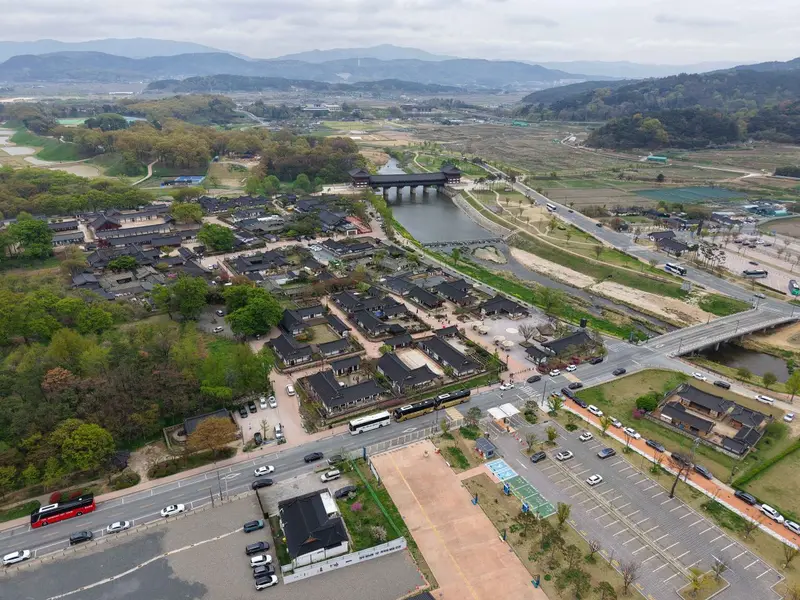
A hanok village on the site of Silla's national academy, founded in 682, which became the local school of the Goryeo and Joseon periods; the names Gyodong, Gyochon and Gyori all mean school village. The Choi family house and Gyeongju Hyanggyo are at its center. Free and open at all times. At 39-2 Gyochon-gil.
- Hours
- Open at all times, every day
- Admission
- Free
Foreigner access
- Korean name
- 교촌마을
- Booking
- No booking; free
- English
- Signs: unconfirmed · Staff: unconfirmed
Choi Family House
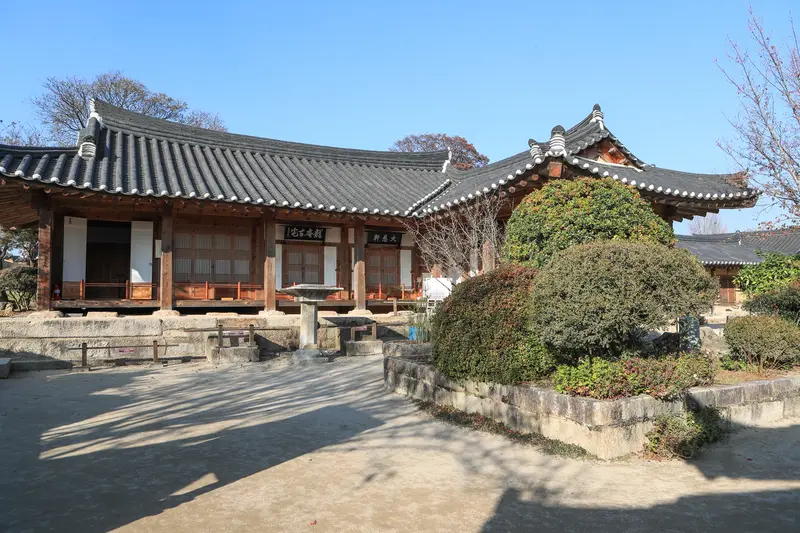
The head house of the Choi family of Gyeongju, said to stand on the site of Yoseokgung, a Silla palace, and to have been built around 1700, though the date is not certain. The men's quarters and a separate wing burned in November 1970; the women's quarters, gate building, storehouse and family shrine remain. The family is remembered for 12 generations of wealth and for its house rules. At 19-21 Gyochonan-gil.
- Hours
- 9:30 to 17:00 (some listings say 17:30); closed on the last Monday of each month
- Admission
- Free
Foreigner access
- Korean name
- 경주 최부자댁
- Booking
- No booking; free
- English
- Signs: Partly · Staff: unconfirmed
Photos from the Korea Tourism Organization show an information board in Korean and English.
Gyeongju Hyanggyo Confucian School
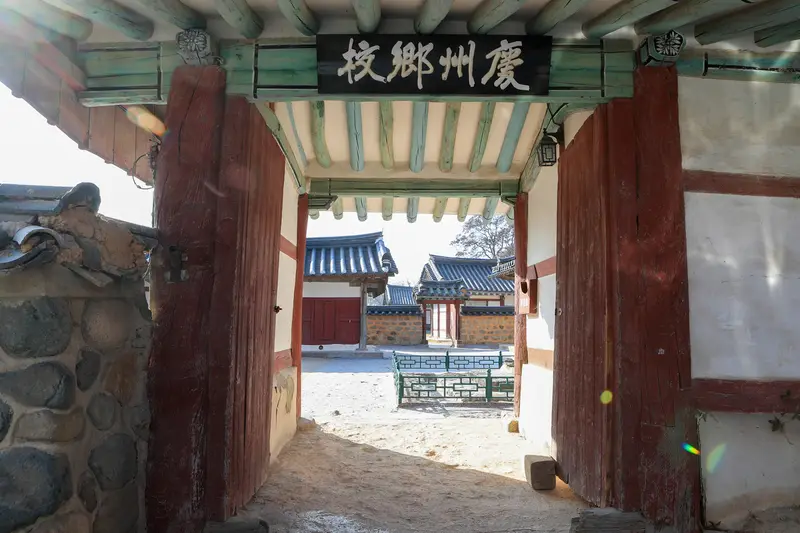
A Confucian school on the site of the Silla academy of 682, rebuilt in 1492 on the layout of the national academy and again after the Imjin War (the Japanese invasions). The shrine halls are at the front and the lecture hall and dormitories behind; it is the largest hyanggyo in the Yeongnam region. Local classes in classical Chinese, calligraphy and folk painting are still held here.
- Hours
- 9:00 to 18:00, every day
- Admission
- Free
Foreigner access
- Korean name
- 경주향교
- Booking
- No booking; free
- English
- Signs: Partly · Staff: unconfirmed
A Korea Tourism Organization photo shows an information board with English.
Gyodong Beopju
The shop of Gyodong beopju, a glutinous rice liquor known as the Choi family's house wine, at the same address as the Choi family house. The business's photos show 900 ml bottles. Closed on Sundays.
- Hours
- Monday to Saturday 9:30 to 18:00. Closed on Sundays
- Prices
- One recent visitor (November 2026) paid 37,500 won for a single bottle; gift sets were 43,500 and 80,000 won
Foreigner access
- Korean name
- 경주교동법주
- Booking
- Walk-in
- English
- Signs: unconfirmed · Staff: unconfirmed
Woljeonggyo and Gyerim
Woljeonggyo Bridge
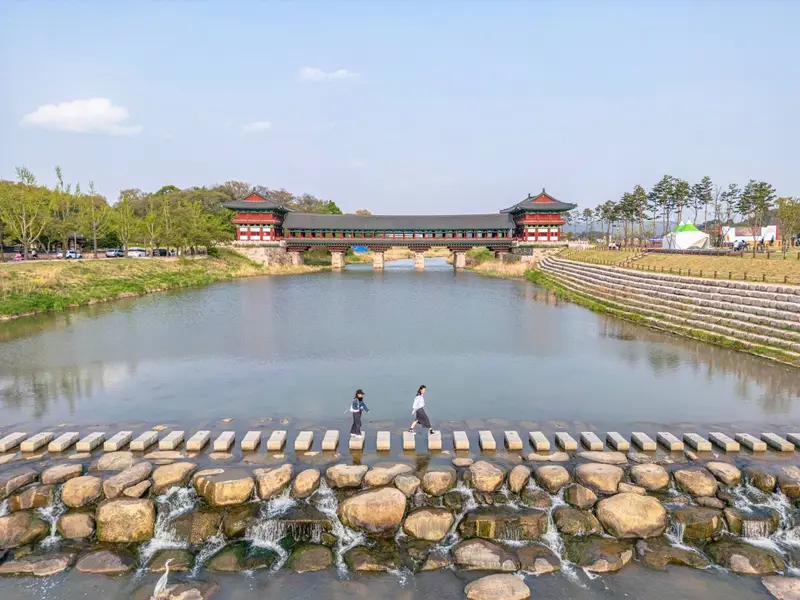
A covered wooden bridge over the Namcheon stream with a gate pavilion at each end. The Samguk Sagi records bridges built south of the palace in 760; this one was lost in the Joseon period and, after about ten years of study, rebuilt in 2013, with the pavilions finished in April 2018. Free, open until 22:00 and lit at night. An exhibition on the 2nd floor of the gate pavilion shows the restoration and excavated objects.
- Hours
- 9:00 to 22:00, every day. The exhibition in the gate pavilion opens at 10:00
- Lights
- Recent visitors say the lights come on around sunset, so the time changes with the season; no fixed time is published
- Admission
- Free
Foreigner access
- Korean name
- 월정교
- Booking
- No booking; free
- English
- Signs: Partly · Staff: unconfirmed
The business's photos on Naver show a name board in Korean and English.
Gyerim Forest
A small wood of old willows and zelkovas between Cheomseongdae and the Wolseong palace site, where Kim Alji, ancestor of the Gyeongju Kim clan, is said to have been found in a golden chest. A stone monument from 1803 records the story. Free and open at all times.
- Admission
- Free
Foreigner access
- Korean name
- 계림
Foreigner access details not yet confirmed
Where to eat
Yangji Sikdang
A small restaurant in the village with two dishes: bean sprout bibimbap and a pancake (pajeon). Its owner appeared as a bean sprout bibimbap master on the SBS program Master of Living in 2016. Closed on Wednesdays. At 30 Gyochon-gil.
Featured on SBS Master of Living (YouTube)
- Hours
- 9:30 to 19:30, break 14:30 to 16:00, last order 19:00. Closed on Wednesdays
- Prices
- Bean sprout bibimbap 10,000 won, pajeon 13,000 won
Foreigner access
- Korean name
- 양지식당
Foreigner access details not yet confirmed
- English
- The menu board in the business's photos on Naver is mostly in Korean.
Gyochon Sambaengnyeonjip
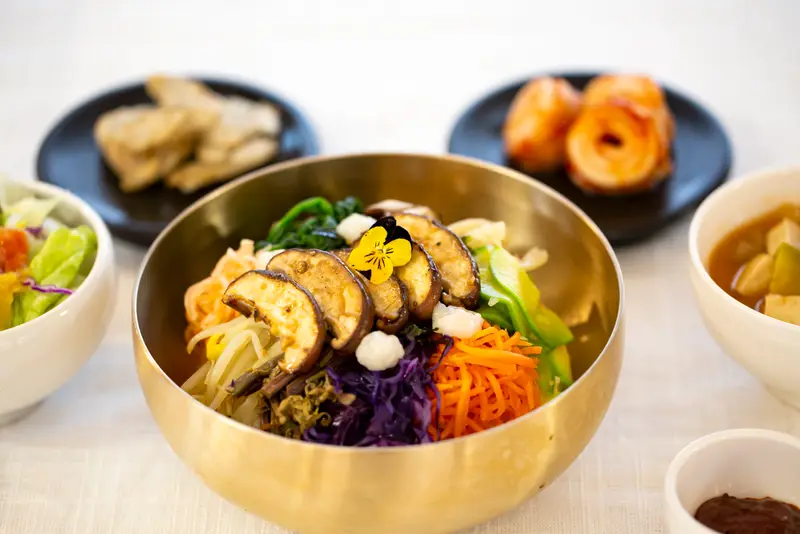
A bibimbap restaurant in a hanok in the village, with several kinds: the house bibimbap, yukhoe bibimbap with raw beef, a flower-topped version and a vegetarian mushroom and water parsley bowl. It also serves cold raw beef soup (yukhoe mulhoe) and braised beef ribs. At 39-19 Gyochon-gil.
Featured on Gungnae Yeohaeng Sajeon (YouTube)
- Hours
- 10:30 to 21:00 daily, break 15:00 to 17:00. Last orders 14:40 for lunch and 19:50 for dinner
- Prices
- House bibimbap 15,000 won, vegetarian mushroom bibimbap 15,000 won, yukhoe bibimbap 18,000 won, flower bibimbap 19,000 won, yukhoe mulhoe 18,000 won, braised beef ribs 38,000 won, seafood pancake 21,000 won
Foreigner access
- Korean name
- 교촌삼백년집 경주본점
- Booking
- Naver Booking
Korean phone number needed: unconfirmed - English
- Menu: unconfirmed · Signs: unconfirmed · Staff: unconfirmed
Whether you can walk in without a booking has not been confirmed. - Queue app
- unconfirmed
Jinsuseongchan
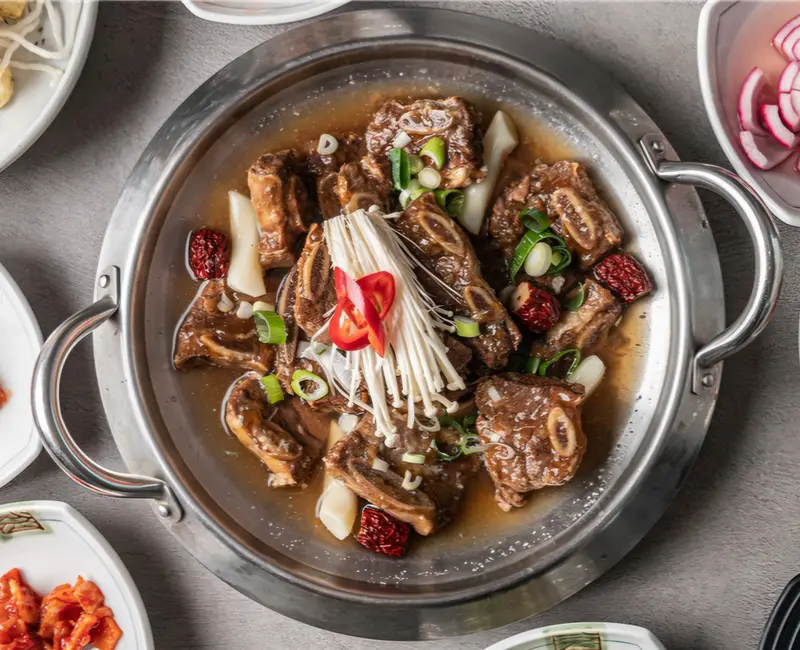
A Korean restaurant in the village for soy-marinated female crab (ganjang gejang), braised beef short ribs with abalone and Korean beef dishes such as yukhoe bibimbap. Pets are allowed. Closed on Wednesdays. At 39-9 Gyochon-gil.
Featured on Sancheonchomok (YouTube)
- Hours
- 10:30 to 21:00, break 15:30 to 16:30, last order 19:50. Closed on Wednesdays
- Prices
- Soy-marinated crab 29,000 won, braised short ribs with abalone 29,000 won, Korean beef yukhoe 29,000 won, yukhoe mulhoe 16,000 won, yukhoe bibimbap, bulgogi bibimbap or mushroom bibimbap 15,000 won
Foreigner access
- Korean name
- 진수성찬
Foreigner access details not yet confirmed
Yoseokgung 1779
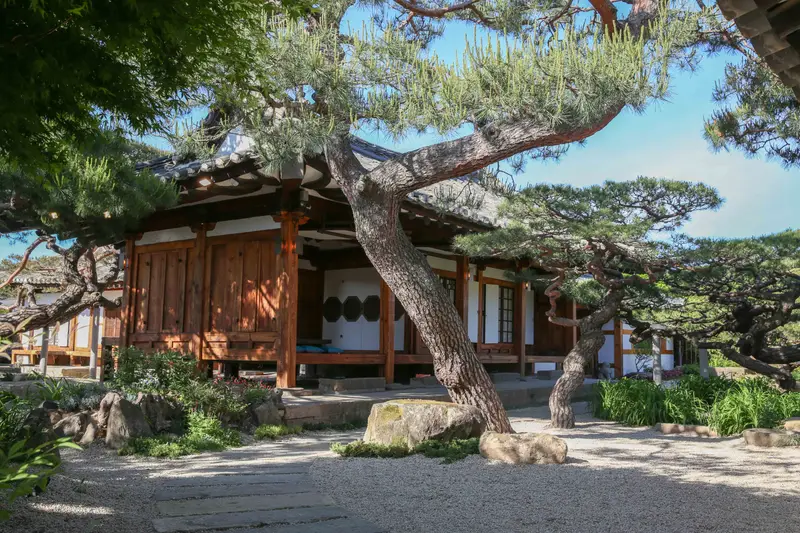
A course-meal restaurant in a hanok next to the Choi family house, serving seasonal Korean courses built on dishes handed down in the Choi family, according to the Korea Tourism Organization. The set meals are expensive: 69,000 won and 120,000 won. Closed on Tuesdays. At 19-4 Gyochonan-gil.
- Hours
- 12:00 to 21:00, break 16:00 to 17:30. Last orders 15:00 for lunch and 20:00 for dinner. Closed on Tuesdays
- Prices
- Jami course 69,000 won, Cheonmi course 120,000 won. The listing does not say whether these are per person
Foreigner access
- Korean name
- 요석궁1779
- Booking
- Reservations by phone (+82-507-1390-3408) or Naver TalkTalk chat; no Naver Booking button
Korean phone number needed: unconfirmed - English
- Menu: unconfirmed · Signs: unconfirmed · Staff: unconfirmed
- Queue app
- unconfirmed
Gyori Gimbap (main shop)
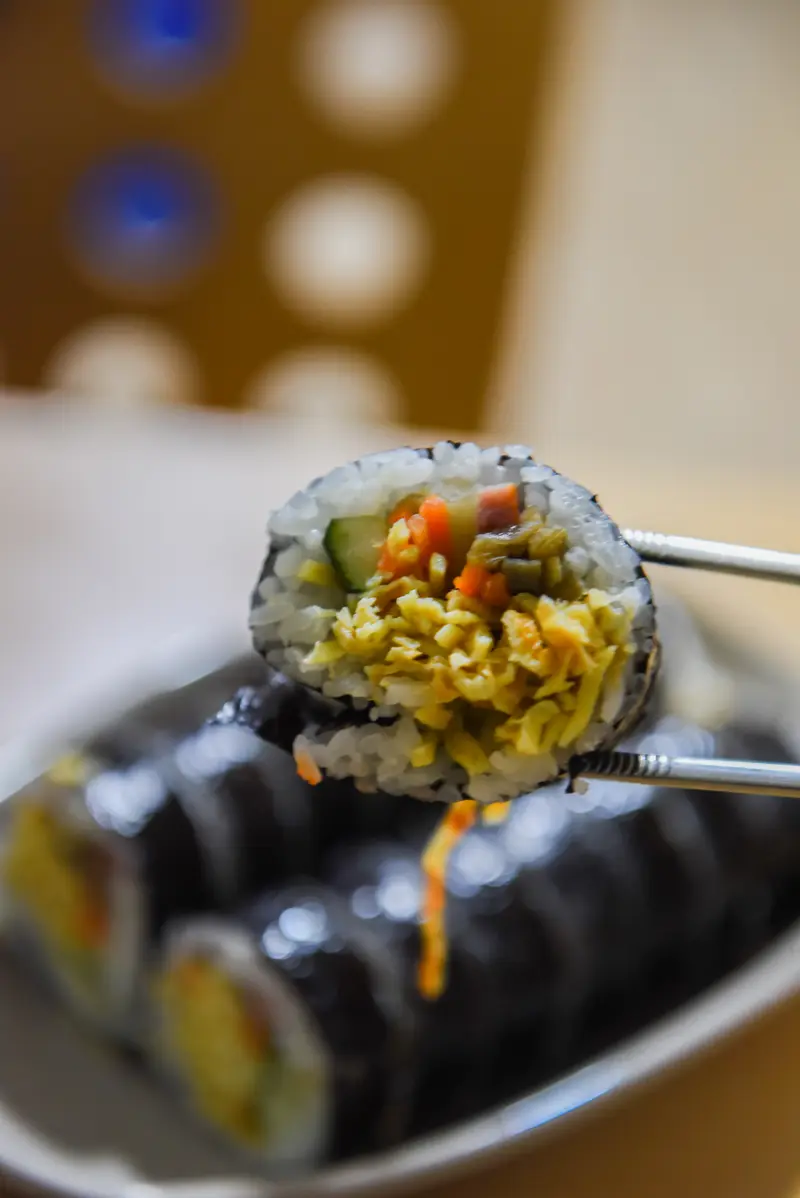
The main shop of Gyori Gimbap, in business for about 50 years according to the Korea Tourism Organization, selling gimbap with a thick filling of shredded egg in boxes of 2 or 3 rolls, and a noodle soup. About 1 km south of Gyochon near the Oreung tombs, on the bus route to Namsan, so you can pick up a box before a hike. Closed on Wednesdays. At 2 Tamni 3-gil.
- Hours
- Weekdays 8:30 to 17:30, weekends 8:30 to 18:30. Closed on Wednesdays
- Prices
- Box of 2 rolls 13,000 won, box of 3 rolls 19,500 won, Gyori noodles 9,000 won
Foreigner access
- Korean name
- 교리김밥 본점
Foreigner access details not yet confirmed
Hotels
Experiences
Sources
- Korea Tourism Organization (TourAPI): Gyochon Village, Woljeonggyo, Gyeongju Choi family house, Gyeongju Hyanggyo, Gyerim, Cheomseongdae, 2026 Gyeongju Heritage Night, Yoseokgung 1779 and Gyori Gimbap main shop entries (Korean; search by name)(accessed 2026-11-14)
- Gyeongju City tourism site: night walk course (Cheomseongdae, Gyerim, Woljeonggyo, Donggung; walking distances and hours) (Korean)(accessed 2026-11-14)
- Gyeongju City tourism site: East Namsan course (Woljeonggyo and the stepping stones) (Korean)(accessed 2026-11-14)
- Gyeongju City tourism site: Joseon-period Gyeongju course (Choi family house, Gyeongju Hyanggyo) (Korean)(accessed 2026-11-14)
- Gyeongju City tourism site: core city-center course (Woljeonggyo exhibition hours) (Korean)(accessed 2026-11-14)
- Gyeongju City Transportation Information Center: bus fares (Korean)(accessed 2026-11-14)
- Saecheonnyeon Miso (Gyeongju city bus operator): route search for Woljeonggyo (Korean)(accessed 2026-11-14)
- Saecheonnyeon Miso: Woljeong 1 stops and timetable (Korean)(accessed 2026-11-14)
- Saecheonnyeon Miso: Woljeong 2 stops and timetable (Korean)(accessed 2026-11-14)
- Saecheonnyeon Miso: Woljeong 3 stops and timetable (Korean)(accessed 2026-11-14)
- Naver Place: Gyeongju Choi family house (hours)(accessed 2026-11-14)
- Naver Place: Gyeongju Gyodong Beopju (hours)(accessed 2026-11-14)
- Naver Place: Woljeonggyo (hours)(accessed 2026-11-14)
- Naver Place: Yangji Sikdang (hours, menu)(accessed 2026-11-14)
- Naver Place: Gyochon Sambaengnyeonjip Gyeongju main restaurant (hours, menu, booking)(accessed 2026-11-14)
- Naver Place: Jinsuseongchan (hours, menu)(accessed 2026-11-14)
- Naver Place: Yoseokgung 1779 (hours, prices, reservations)(accessed 2026-11-14)
- Naver Place: Gyori Gimbap main shop (hours, menu)(accessed 2026-11-14)
- Naver blog: buying Gyodong beopju, prices and delivery (2026-11-06)(accessed 2026-11-14)
- Naver blog: Woljeonggyo lights from sunset to 22:00 (2026-11-06)(accessed 2026-11-14)
- Naver blog: Woljeonggyo and Cheomseongdae free until 22:00, lighting time varies (2026-11-10)(accessed 2026-11-14)
- Naver blog: Woljeonggyo lights after sunset and the free public parking lot (2026-11-10)(accessed 2026-11-14)
- Naver blog: Woljeonggyo lights in late October (2026-10-29)(accessed 2026-11-14)
- Naver blog: Woljeonggyo free parking (2026-11-10)(accessed 2026-11-14)
- Naver blog: photographing Woljeonggyo from the stream bank (2026-11-12)(accessed 2026-11-14)
- Naver blog: a short walk round Gyochon (2026-11-06)(accessed 2026-11-14)
- Naver blog: Daereungwon, Cheomseongdae, Gyochon and Woljeonggyo in order (2026-11-13)(accessed 2026-11-14)
- Naver blog: Gyochon and Woljeonggyo at sunset, then Donggung (2026-11-12)(accessed 2026-11-14)
- Naver blog: Cheomseongdae and Gyerim to Woljeonggyo and Donggung (2026-10-29)(accessed 2026-11-14)
- Naver blog: ginkgo trees at Woljeonggyo and Gyochon in autumn (2026-11-12)(accessed 2026-11-14)
- Naver blog: a walk round Gyochon in hanbok (2026-11-04)(accessed 2026-11-14)
- Naver blog: hanbok walk through Gyochon and Woljeonggyo (2026-11-12)(accessed 2026-11-14)