Seoul Forest
A free 24-hour park beside Seongsu, on an old racecourse and waterworks, with sika deer, a tulip path and ginkgo trees
Intro
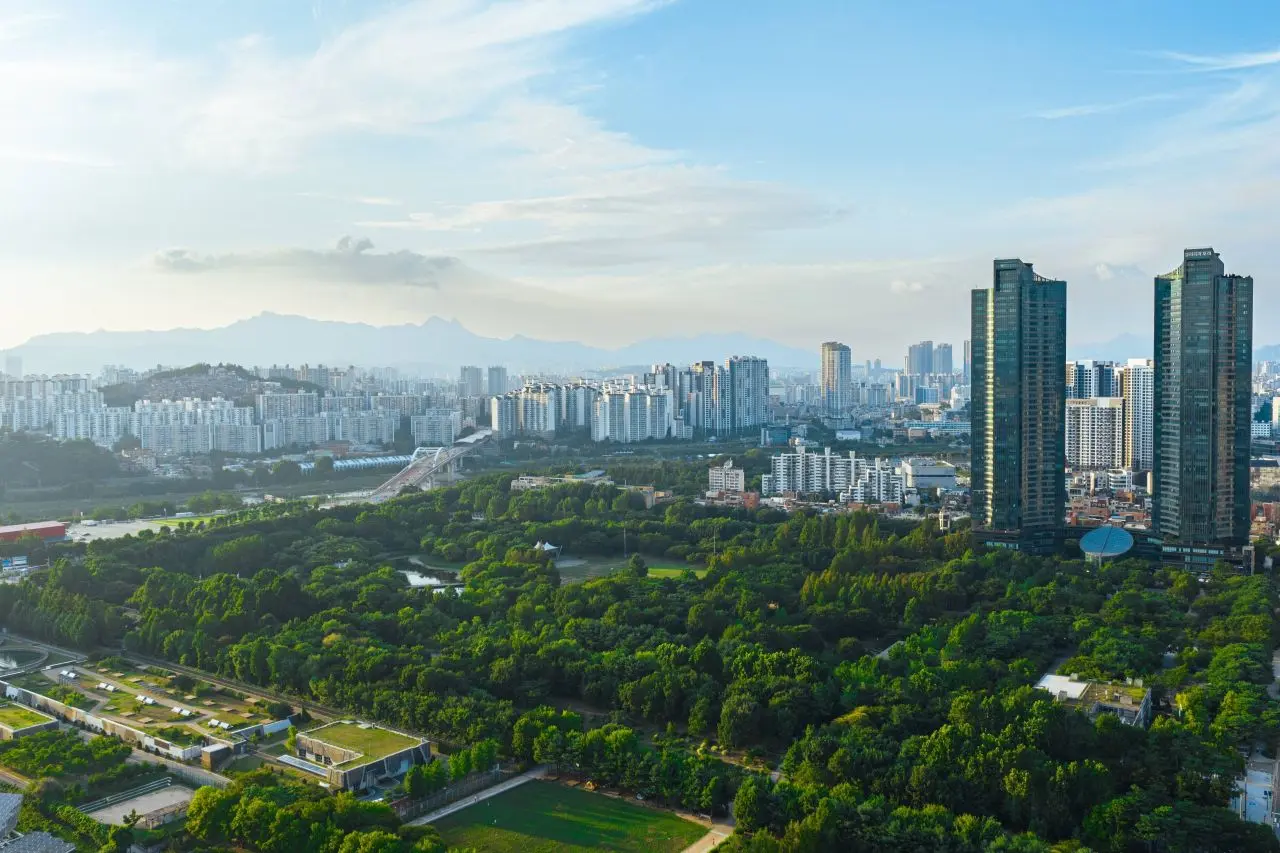
Seoul Forest is a city park of about 48 hectares in Seongdong-gu, next to Seongsu. It is open 24 hours a day, every day, and it is free, including the insect garden and the butterfly garden. The land was a royal hunting ground, then the site of Seoul’s first waterworks, built in 1908, and later a racecourse and a golf course. In 2002 the city chose to make a park here instead of building on it, and it opened on June 18, 2005, with money and volunteer work from about 5,000 citizens.
For a visitor it is a walk of an hour or two between Seongsu’s shops and cafes: sika deer in a wooded enclosure, a shallow pond that reflects the trees, a tulip path in April and ginkgo trees that turn yellow in November. On a sunny weekend you also see how Seoul people spend a day off, on picnic mats with takeout from the cafes next door.
What to see
- The racehorse sculpture: a bronze group of galloping horses near the entrance, titled Start, which marks the park’s past as a racecourse.
- The tulip path (bulb garden): a 4,000 m² strip of tulips, daffodils and other bulbs that starts at the racehorse sculpture and runs along the path. Tens of thousands of tulips bloom here in spring.
- The mirror pond: a pond only 3 cm deep, where the metasequoia trees and the towers beyond are reflected. The park calls it one of its best-known photo spots.
- The sika deer and the Eco Forest: a wooded area made to resemble a wild forest, with an enclosure of sika deer, which the park calls its symbol. The Eco Forest is open from 5:30 to 21:30. Feed has not been sold at the enclosure since January 1, 2020.
- The footbridge and the Hill of Wind: the footbridge crosses above the Eco Forest, so you look down on the deer, and continues from the Hill of Wind, the highest point of the park and a slope of silver grass, toward the Han River park.
- The ginkgo forest: about 600 ginkgo trees along a forest path, a well-known spot for autumn color in November.
- The Insect Botanical Garden: a two-floor glasshouse in a former filtration building of the waterworks, with about 100 kinds of tropical plants, insects, reptiles and amphibians. It reopened in January 2025 after a renovation. Free, closed on Mondays, and open only until 16:00 from November to February.
- The Butterfly Garden and the Gallery Garden: the Butterfly Garden opens from May to October. In front of it, the Gallery Garden (1,600 m²) is planted with flowers and climbing plants on the concrete settling tanks of the old waterworks.
- The floor fountain and the central lake: a floor fountain with 100 jets where children play in the water in summer, and a lake with a fountain that runs at 12:00, 13:00 and 18:00 from March to October.
The Family Lawn, the large lawn by the entrance that the park suggests for picnics, has been closed for lawn repair since November 4, 2026, until the work is finished; the park asks visitors to use the other gardens in the meantime.
Through the seasons
- Spring: the cherry trees usually bloom in early April, and the tulips usually follow from mid to late April.
- Summer: the floor fountain runs from May, and the Butterfly Garden is open.
- Autumn: the ginkgo trees usually turn yellow in early to mid November, together with the metasequoias and maples. In 2026 they were at their peak in the second week of November.
- Winter: the Butterfly Garden is closed and the Insect Botanical Garden closes at 16:00. The park itself stays open around the clock.
2026 events that have ended
Seoul Forest was the center of the 2026 Seoul International Garden Expo, held from May 1 to October 27, 2026. The expo has closed, but many gardens from the expo remain. The Pokemon garden set up in the ginkgo forest ran until June 21, 2026, and has also ended. The 2027 expo moves to Namsan Park.
What Seoul people do here
On weekends the lawns fill with picnic mats and folding chairs. Many people pick up bread, gimbap or other takeout from the Seongsu shops and eat in the park. Families come to see the deer, couples and wedding photographers use the ginkgo trees and the mirror pond as backdrops, and a lot of visitors pair the park with a cafe and a pop-up store in Seongsu for a half day.
Picnic and park rules
- People bring mats and folding chairs, but tents and sunshades are not allowed.
- No camping, cooking or fires outside designated areas (fine 100,000 won), and no street vendors. Littering is fined 30,000 won.
- Ball games are limited to young children of preschool age playing catch with a soft ball with an adult; no bats. Kites are not allowed.
- The park is in a drone no-fly zone.
- Dogs are welcome on a lead of 2 m or less. Keep them off the lawns and garden beds and off benches. Dogs must be on a lead and owners must clean up after them; breaking these rules can bring a fine.
- Ride bicycles slowly and keep off the lawns, gardens and narrow paths. There is no bike rental inside the park; Seoul’s public bikes, Ttareungyi, are docked outside it. Motorbikes and Segways are restricted (fine 50,000 won), and so is picking flowers or fruit (fine 50,000 won).
- Drinking is not banned, but Seoul Forest is one of the city parks designated an alcohol-free zone in 2018, which means drunken noise or nuisance can be fined.
- There are eight toilets open 24 hours, and a nursing room at the visitor center.
Food and cafes next to the park
Plan to buy food and coffee outside the park, on the Seongsu side. The cafe street on Seoulsup 4-gil and the lanes near Seoul-forest Station have several places that are on our other pages:
- Korean meals: Nanpo Seongsu (beef tartare and aged kimchi rolls 22,000 won, gomguk 16,000 won) and Daban Seongsu next door (set meals 23,000 won). See Seongsu.
- Local restaurants: Beoseotjip for mushroom and beef bulgogi hot pot (17,000 won) and mushroom soups (10,000 to 11,000 won), and Food Gallery Bean for its own tofu in set meals (12,000 won). See Where Seoul Locals Eat.
- Cafes: Mesh Coffee, a tiny roastery coffee bar; 5to7 Seongsu for souffle pancakes (20,000 to 23,000 won); and Notredon for French pastry (mousse cakes 14,000 won). See Seoul’s Feel-Good Cafes.
How long to spend and when to go
Allow 1 to 2 hours for a walk past the deer, the mirror pond and the ginkgo forest, and longer with a picnic or children.
A morning walk here pairs well with Seongsu: see the park first, then go on to the shops; their hours are on the Seongsu page. On Mondays the park is open, but the Insect Botanical Garden and Butterfly Garden are closed and the floor fountain is off for inspection. Weekends are the busiest, and the car parks fill up, so come by subway.
Getting there
Take the Suin-Bundang Line to Seoul-forest Station. The park is about 2 minutes from Exit 4; Exit 3 comes out in front of Understand Avenue, and you can walk through it into the park. From Line 2, Ttukseom Station Exit 8 is about 10 minutes on foot.
Buses stop at the “Seoul Forest” stop (green buses 2014, 2224, 2412 and 2413, and blue bus 121) and at “Ttukseom Seoul Forest” (blue buses 141, 145, 148 and 463).
The park connects to the Han River and Jungnangcheon bike paths through a tunnel near Yongbigyo Bridge, or over the footbridge when the tunnel is closed. A Hangang Bus stop opened nearby; check the official Hangang Bus site for times and fares, and see Hangang Parks for how the river bus works. For finding the right exit on a phone, see Map apps in Korea.
Combine with
- Seongsu: brand flagship stores, pop-ups and cafes in converted factories. See Seongsu, or the full-day Seongsu course in Seoul Day Plans.
- More big parks: for silver grass at Haneul Park, Olympic Park and other large parks by season, see Seoul’s Big Parks.
- The Han River: for riverside parks, picnics and bikes, see Hangang Parks.
More sights are on the Seoul page.
Get There
Seoul-forest StationSuin-Bundang Line
- Korean
- 서울숲역
- Exit
- Exit 4 or Exit 3
- Walk
- 2 min
The park gives about 2 minutes on foot from Exit 4. Exit 3 comes out in front of Understand Avenue, and you can walk through it into the park. Seoul-forest is the station's official English spelling; the park is Seoul Forest Park.
Ttukseom StationLine 2
- Korean
- 뚝섬역
- Exit
- Exit 8
- Walk
- 10 min
About 10 minutes on foot. Handy if you are coming from Seongsu or elsewhere on Line 2.
Hours & Fees
- Park
- Open 24 hours, every day. Free
- Eco Forest (deer enclosure and footbridge)
- 5:30 to 21:30, every day
- Insect Botanical Garden
- March to October 10:00 to 17:00 (last entry 16:30); November to February 10:00 to 16:00 (last entry 15:30). Closed on Mondays. Free
- Butterfly Garden
- May to October only, 10:00 to 17:00 (last entry 16:30). Closed on Mondays, and closed from November to April. Free
- Floor fountain
- Runs from May to September or October, several 30-minute runs between about 12:00 and 17:00. Not on Mondays (inspection day) or on and just after rainy days. The two official timetables differ, so call the park office if you are planning around it
- Visitor center
- 9:00 to 18:00, every day. Free wheelchair and stroller loan for up to 2 hours, with ID or a phone number
- Parking
- 211 spaces, 200 won per 5 minutes for cars (400 won for large vehicles), open 24 hours. The car parks fill up on weekends, so take the subway
- Park office
- +82-2-460-2905
- Typical visit
- 1 to 2 hours for a walk past the deer, the mirror pond and the ginkgo trees; longer with a picnic or children
Places in Seoul Forest
Seoul Forest Park
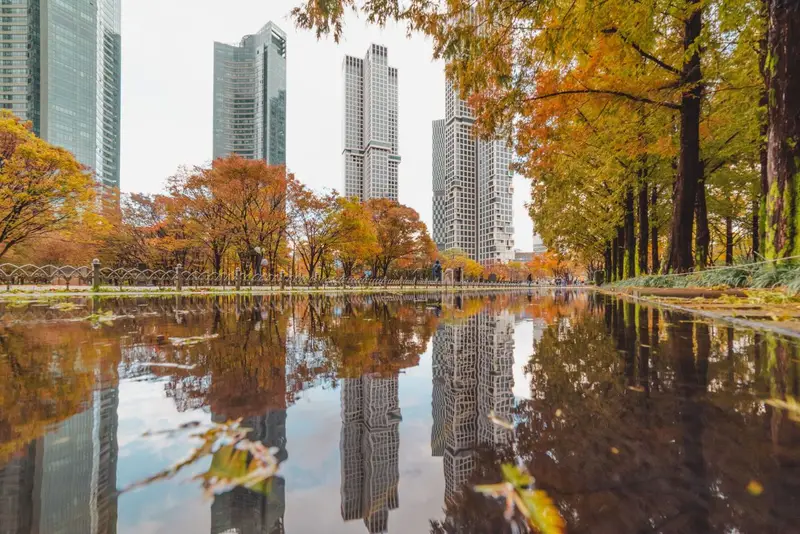
A free park of about 48 hectares at 273 Ttukseom-ro, Seongdong-gu, open 24 hours every day, next to Seoul-forest Station. It opened in June 2005 on land that held Seoul's first waterworks and later a racecourse and a golf course. Sika deer, a tulip path in April, ginkgo trees in November and a free insect garden are inside; the insect and butterfly gardens close on Mondays.
- Park
- Open 24 hours, every day. Free
- Eco Forest (deer)
- 5:30 to 21:30, every day
- Insect Botanical Garden
- March to October 10:00 to 17:00, November to February 10:00 to 16:00 (last entry 30 minutes before closing). Closed on Mondays. Free
- Butterfly Garden
- May to October only, 10:00 to 17:00 (last entry 16:30). Closed on Mondays. Free
Foreigner access
- Korean name
- 서울숲
- Booking
- No booking; walk in. Only the tennis courts, sports ground and photo shoots are booked, through the Seoul public service booking site in Korean
- English
- Signs: unconfirmed · Staff: unconfirmed
Understand Avenue
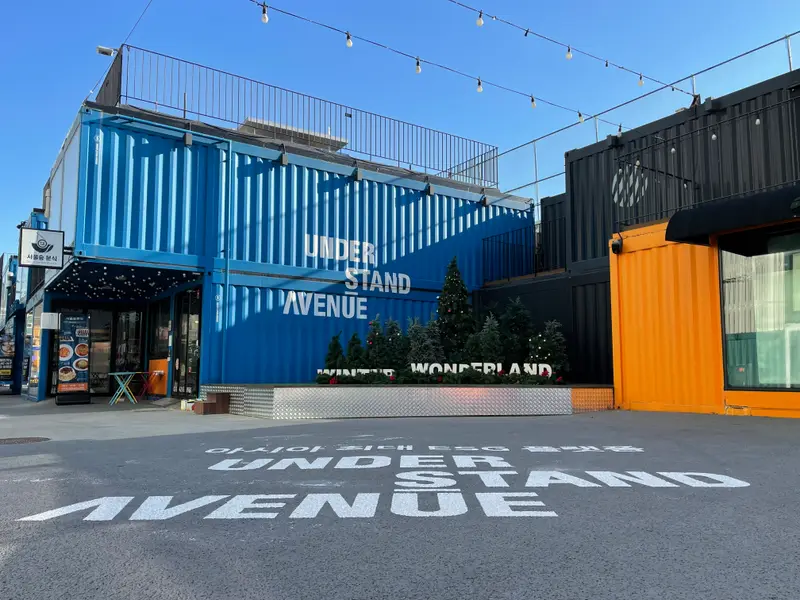
A complex of 116 shipping containers with small shops, pop-ups and cafes, opened in April 2016, in front of Exit 3 of Seoul-forest Station. You can walk through it into the park. On Google Maps, use the English pin Under Stand Avenue; a Korean search finds a cafe inside instead.
- Hours
- 10:00 to 22:00, daily
Foreigner access
- Korean name
- 언더스탠드에비뉴
- Booking
- No booking to enter
- English
- Signs: unconfirmed · Staff: unconfirmed
Hotels
Experiences
Sources
- Seoul Parks: Seoul Forest park details, facilities, transport and visitor notes (Korean)(accessed 2026-11-13)
- Seoul Forest mini site: park introduction, facilities, rentals, buses and parking (Korean)(accessed 2026-11-13)
- Seoul Forest mini site: opening hours of the Eco Forest, Insect Botanical Garden, Butterfly Garden and fountains (Korean)(accessed 2026-11-13)
- Seoul Forest mini site: things to see in the park (Korean)(accessed 2026-11-13)
- Seoul Forest mini site: rules for using park facilities (Korean)(accessed 2026-11-13)
- Seoul Forest mini site: frequently asked questions (Korean)(accessed 2026-11-13)
- Seoul Parks notice: Family Lawn closed for lawn repair from November 4, 2026 (Korean)(accessed 2026-11-13)
- Seoul Forest FAQ, former Seoul Forest Conservancy site (Korean)(accessed 2026-11-13)
- Seoul Media Hub: Insect Botanical Garden reopens after renovation (Korean, January 2025)(accessed 2026-11-13)
- Seouland: 600 ginkgo trees in Seoul Forest (Korean, November 2024)(accessed 2026-11-13)
- Newsis: tulips planted in Seoul Forest from the racehorse sculpture along the paths (Korean, April 2024)(accessed 2026-11-13)
- Yonhap: Seoul Forest tulips bloom from the second week of April (Korean, March 2019)(accessed 2026-11-13)
- Sisa Focus: Seoul Forest cherry blossom path (Korean, April 2025)(accessed 2026-11-13)
- Newsworks: Seoul spring flower roads and cherry blossom forecast, Seoul Forest included (Korean, April 2022)(accessed 2026-11-13)
- Newsis: 2026 Seoul International Garden Expo closes after 180 days (Korean, October 2026)(accessed 2026-11-13)
- Edaily: most expo gardens to be kept after the 2026 Seoul International Garden Expo (Korean, October 2026)(accessed 2026-11-13)
- Global Economic: Pokemon Secret Forest garden in Seoul Forest until June 21, 2026 (Korean)(accessed 2026-11-13)
- Aju Business Daily: Pokemon garden on the ginkgo forest site in Seoul Forest (Korean, April 2026)(accessed 2026-11-13)
- Newspim: the 2027 Seoul International Garden Expo to be held at Namsan Park (Korean, November 2026)(accessed 2026-11-13)
- Financial News: Hangang Bus winter timetable and Seoul Forest pier (Korean, November 2026)(accessed 2026-11-13)
- Kyunghyang Shinmun: Seoul city parks become alcohol-free zones, fines for drunken nuisance (Korean, December 2017)(accessed 2026-11-13)
- Asia Economy: how the park drinking rules work (Korean, April 2024)(accessed 2026-11-13)
- Naver Place listing for Seoul Forest(accessed 2026-11-13)
- Naver Place listing for Understand Avenue(accessed 2026-11-13)
- Naver blog: picnic on the Family Lawn (Korean, 2026-11-12)(accessed 2026-11-13)
- Naver blog: the sika deer enclosure (Korean, 2026-11-09)(accessed 2026-11-13)
- Naver blog: ginkgo trees at their peak (Korean, 2026-11-13)(accessed 2026-11-13)
- Naver blog: ginkgo forest, last year's peak and the deer from the footbridge (Korean, 2026-11-08)(accessed 2026-11-13)
- Naver blog: autumn walk in Seoul Forest and how long it takes (Korean, 2026-11-11)(accessed 2026-11-13)