Gyeongbokgung Palace
The first and largest Joseon palace, free to enter in hanbok, with a royal guard ceremony at its main gate
Intro
Gyeongbokgung was built in 1395 as the main royal palace of the new Joseon dynasty, and it is the largest of the Joseon palaces. Hunminjeongeum, the original Korean alphabet, was proclaimed here in the reign of King Sejong. The palace burned in 1592 and was rebuilt in 1867. Under Japanese rule most of its buildings were torn down from 1915, and the Japanese Government-General building was put up in its place in 1926. Restoration began in the 1990s: the Government-General building was demolished between 1995 and 1997, Gwanghwamun and Heungnyemun gates and other buildings were rebuilt between 2001 and 2021, and Gyejodang hall followed in 2023.
Gyeongbokgung is a reason to come to Seoul in itself: it is the first and largest palace of the Joseon dynasty, in the middle of the city, where you can walk the grounds in hanbok for free and watch the royal guard ceremony at the main gate on the same visit.
What to see
The official walking courses run north from the main gate, Gwanghwamun, through Heungnyemun Gate to the throne hall, then past the king’s and queen’s quarters to the ponds at the back. The 40-minute course covers Heungnyemun, Geunjeongjeon, Sajeongjeon, Sujeongjeon and Gyeonghoeru; the 90-minute course continues to Hyangwonjeong.
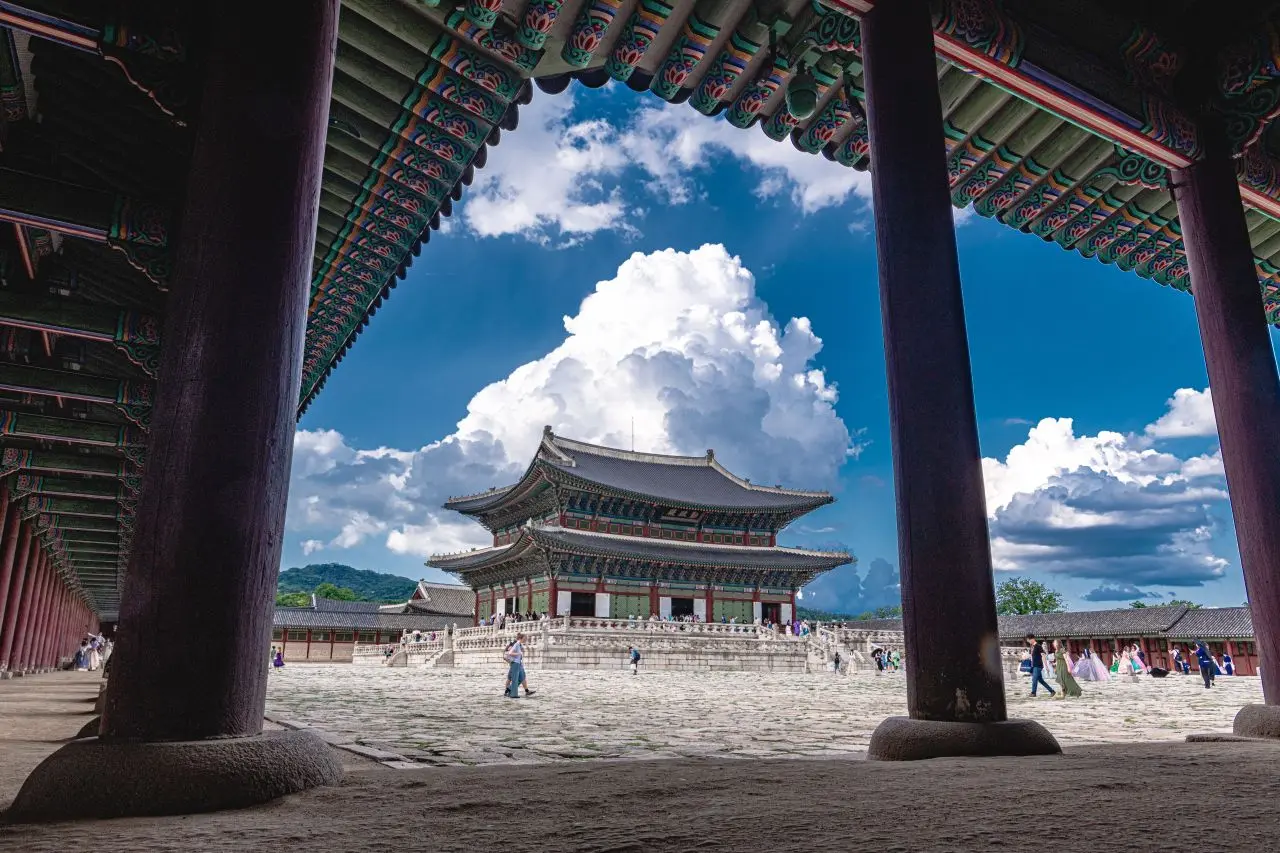
Geunjeongjeon (Throne Hall) is a National Treasure and the hall where coronations, court assemblies and receptions for foreign envoys were held. The present building dates from 1867. It has a two-tiered roof, carvings of the twelve zodiac animals on the balustrades of its raised stone terrace, rows of rank stones in the courtyard, and a painting of the sun, moon and five peaks behind the throne. Access to the stone terrace is sometimes closed in the busy autumn season to protect the stonework, as it was from September to October 2026.
Gyeonghoeru Pavilion, also a National Treasure, stands on a square island in a pond northwest of the throne hall, reached by three stone bridges. It was rebuilt on a larger scale in 1412 and again in 1867, was used for royal banquets, and is the largest pavilion of its kind in Korea according to the national heritage record. The inside is open only on special tours in Korean, booked online, and the palace states that foreign visitors who cannot follow the Korean commentary cannot join. For most visitors, it is a view from the edge of the pond.
Gangnyeongjeon and Gyotaejeon were the king’s and the queen’s living quarters, restored from 1994. Behind Gyotaejeon is Amisan, a small garden with chimneys, which the palace describes as the place thought to connect the quarters to the mountain range of Baekdusan.
Hyangwonjeong Pavilion, a Treasure, is a six-sided two-story pavilion on an island in the pond at the north end of the palace, believed to date from 1885. Its wooden bridge was lost in the Korean War and rebuilt on its original north side in 2021.
Geoncheonggung is a residence within the palace built by King Gojong in 1873. Empress Myeongseong was killed here, at Okhoru, in 1895.
Royal Guard Changing Ceremony
The ceremony recreates the changing of the palace gate guard in early Joseon uniforms and with period weapons, and has been staged since 2002. It takes place at Gwanghwamun Gate:
| Event | Time | Length |
|---|---|---|
| Guard open training | 9:35 and 13:35 | about 15 minutes |
| Royal Guard Changing Ceremony | 10:00 and 14:00 | about 20 minutes |
| Gwanghwamun gate guard ceremony | 11:00 and 13:00, then hourly guard duty at the gate | about 10 minutes |
The palace is closed on Tuesdays; whether the ceremony is held on Tuesdays has not been confirmed, so check the schedule before you go. It is suspended during severe heat wave warnings and has been rescheduled on special days: on the national university entrance exam day in November 2025, the palace opened at 10:00 and the first ceremony moved to 10:10. From March to May and September to November, a guard patrol runs from 15:00 to 16:00 on Saturdays, Sundays and holidays, inside the palace on Saturdays and from Gwanghwamun to Insadong on Sundays (it can be moved inside the palace, for example during demonstrations). Do not touch the guards’ equipment, speak to the guards or walk through the procession.
Whether the ceremony is cancelled in rain, and whether there is any English commentary on site, has not been confirmed.
Free entry in hanbok
Anyone wearing hanbok enters free, foreigners included. The palace guidelines require both parts: a top that wraps across the front (jeogori) and a skirt or traditional-cut trousers. Traditional and modern hanbok both count, and the top does not need ties. A long coat (durumagi) on its own, jeans with a hanbok top, a hanbok skirt with a T-shirt, a dress without a separate top, and T-shirt-style tops do not count. A wrap-around skirt counts if the top reaches the waist.
Rental shops cluster by Exits 3, 3-1 and 4 of Gyeongbokgung Station. At the first three shops below, a standard hanbok costs 15,000 to 40,000 won for 2 hours, 20,000 to 45,000 won for 4 hours and 30,000 to 100,000 won for the day; Hanboknam lists 10,000 to 30,000 won. Premium and themed outfits cost more. All four take bookings through Naver Booking, which needs a Naver login. Whether they accept walk-ins or speak English has not been confirmed, and whether every outfit they rent meets the palace guidelines has not been checked: if you choose a fusion or character outfit, make sure it has a wrap-front top and a skirt or trousers.
Tours in English
Free English tours of the palace start at 11:00, 13:30 and 15:30 every day except Tuesday, in front of the information center just inside Heungnyemun Gate. You only need an admission ticket (or hanbok), and groups of fewer than 10 do not book. Tours last 1 to 1.5 hours. Tours in Japanese and Chinese run at other times. The two museums run their own free English tours (see the museum cards below).
Night openings
Night openings are held for limited periods, usually in spring and early autumn; in 2026 they ran from mid-May to mid-June and from early September to early October, from 19:00 to 21:30 (last entry 20:30), not on Mondays or Tuesdays, for 3,000 won. Dates and tickets are announced on the official site, and tickets are sold online in advance through a Korean ticketing site (NOL Ticket in the second half of 2026). Some tickets are kept for foreign visitors on site, 300 a night in 2026, up to two per person, with a passport. Visitors in hanbok, those aged 65 and over and children 6 and under enter free without a ticket, showing ID. Whether online booking works without a Korean phone number has not been confirmed. At night only the central part of the palace is open: Gwanghwamun, Heungnyemun, Geunjeongjeon, Gyeonghoeru, Sajeongjeon, Gangnyeongjeon, Gyotaejeon and Amisan.
How long to spend
Allow 40 to 90 minutes for the official walking courses, or 1 to 1.5 hours for an English tour. Add the National Palace Museum and the National Folk Museum and it becomes half a day.
When to go
The palace is closed on Tuesdays; if you want to see the guard ceremony on a Tuesday, check the schedule first. Opening hours change with the season (see Hours & Fees), and last entry is 1 hour before closing. If you are in Seoul on a Tuesday, the National Palace Museum is open. To combine the guard ceremony with an English tour, arrive for the 10:00 ceremony and join the 11:00 tour.
In early to mid-November, recent visitors’ posts show yellow ginkgo along Hyoja-ro on the palace’s west side and autumn leaves around Hyangwonjeong and Gyeonghoeru. The palace sometimes waives admission for festival periods, as it did in autumn 2026; these are announced in the notices on the official site.
Getting there
Take Line 3 to Gyeongbokgung Station: Exit 5 is 2 minutes from the palace. Anguk Station (Line 3, Exit 1) and Gwanghwamun Station (Line 5, Exit 2) are 6 to 10 minutes away on foot, depending on the source. City buses stopping at Gyeongbokgung are 109, 171, 272, 601, 606, 710, 1020 and 7025. For finding the palace and the rental shops on a phone, see Map apps in Korea.
Combine with
- Bukchon and Samcheong-dong: the hanok lanes and cafe street of Bukchon and Samcheong-dong begin on the palace’s east side, beyond the National Folk Museum gate on Samcheong-ro. See Bukchon and Samcheong-dong.
- Gwanghwamun Square: the open square in front of Gwanghwamun Gate, where the guard ceremony takes place.
- Seochon: the neighborhood of lanes on the palace’s west side, starting near Exit 3 of Gyeongbokgung Station where the hanbok shops are.
- Insadong: to the east toward Anguk Station, and the end point of the Sunday guard patrol. See Insadong and Ikseondong.
- Deoksugung: south along Sejong-daero from Gwanghwamun Gate, open until 21:00 and on the same combined palace pass. See Deoksugung Palace and Jeongdong-gil.
- Jongmyo Shrine: the royal shrine of the Joseon kings, on the same combined palace pass and, like Gyeongbokgung, closed on Tuesdays. See Jongmyo Shrine.
Get There
Gyeongbokgung StationLine 3
- Korean
- 경복궁역
- Exit
- Exit 5
- Walk
- 2 min
The closest exit. The National Palace Museum is about 5 minutes from the same exit. The hanbok rental shops are by Exits 3, 3-1 and 4.
Anguk StationLine 3
- Korean
- 안국역
- Exit
- Exit 1
- Walk
- unconfirmed
6 minutes on foot according to the palace's official site, about 10 minutes according to the guard ceremony organizer. The National Folk Museum is about 15 minutes from this exit.
Gwanghwamun StationLine 5
- Korean
- 광화문역
- Exit
- Exit 2
- Walk
- unconfirmed
6 minutes on foot according to the palace's official site, about 7 minutes according to the guard ceremony organizer.
Hours & Fees
- Hours (January, February, November, December)
- 9:00 to 17:00 (last entry 16:00)
- Hours (March to May, September, October)
- 9:00 to 18:00 (last entry 17:00)
- Hours (June to August)
- 9:00 to 18:30 (last entry 17:30)
- Closed
- Tuesdays. When a Tuesday is a public holiday, the palace opens and closes on the next day that is not a holiday
- Admission
- 3,000 won for foreign visitors aged 19 to 64 (the same price as for Koreans); 2,400 won each for groups of 10 or more. Tickets are bought on the day; there is no booking for daytime visits
- Free admission
- Ages 18 and under, ages 65 and over, and anyone wearing hanbok that meets the palace guidelines
- Combined palace pass
- 6,000 won: one entry each to Gyeongbokgung, Changdeokgung (not the Secret Garden), Changgyeonggung, Deoksugung and Jongmyo Shrine, valid for 6 months from purchase. Sold at the ticket offices of these sites. Not refundable once one entry is used
- English guided tour
- 11:00, 13:30 and 15:30 (not on Tuesdays). Meet in front of the information center inside Heungnyemun Gate. Free with an admission ticket, no booking for fewer than 10 people. 1 to 1.5 hours
- Royal Guard Changing Ceremony
- 10:00 and 14:00 at Gwanghwamun Gate (about 20 minutes). The palace is closed on Tuesdays; whether the ceremony is held on Tuesdays has not been confirmed, so check the schedule
- Typical visit
- 40 to 90 minutes on the official walking courses; half a day with the two museums
Places in Gyeongbokgung Palace
Gyeongbokgung Palace
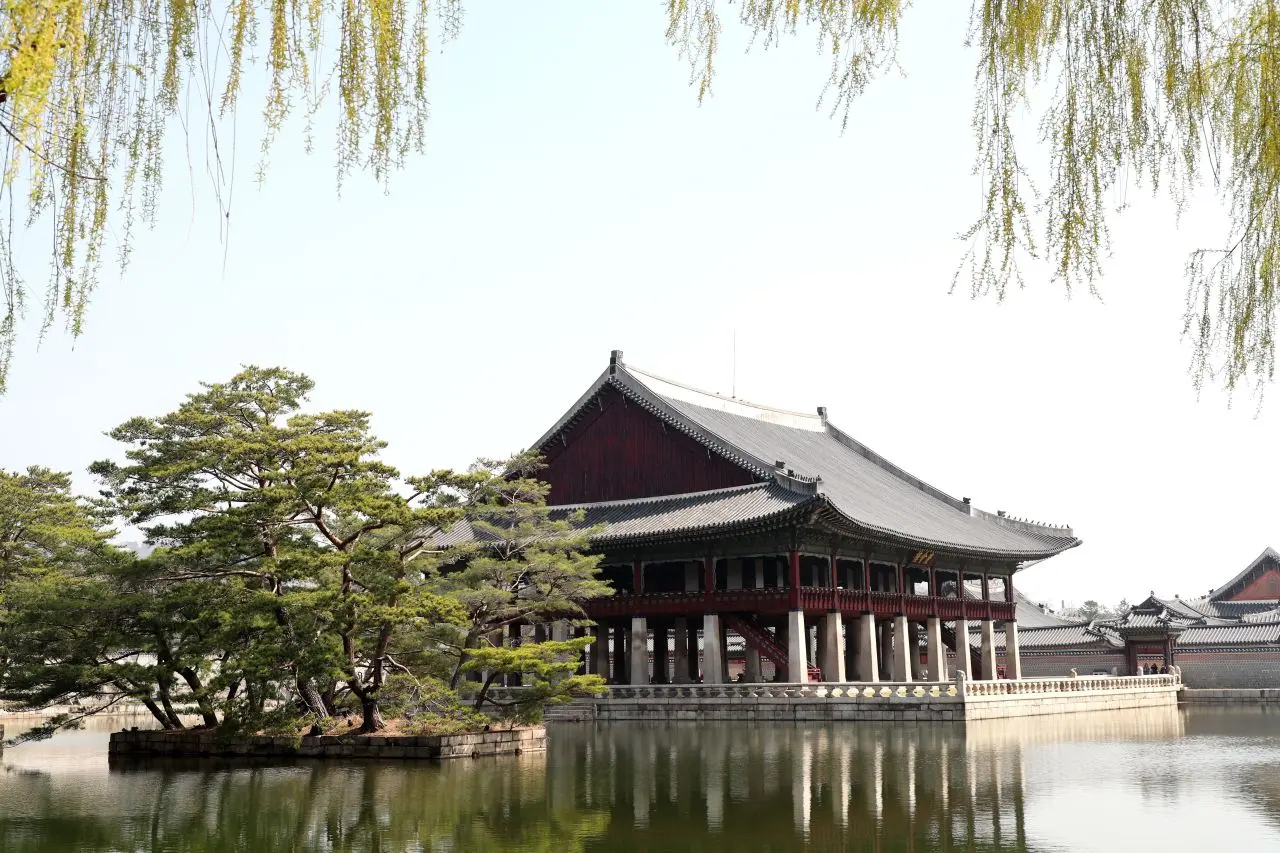
The main palace of the Joseon dynasty, at 161 Sajik-ro, Jongno-gu, 2 minutes from Exit 5 of Gyeongbokgung Station. Hours, fees and tour times are in the Hours & Fees section above. Phone: +82-2-3700-3900 (palace management office).
Foreigner access
- Korean name
- 경복궁
- Booking
- No booking for daytime visits; buy a ticket on the day
Korean phone number needed: No - English
- Signs: unconfirmed · Staff: unconfirmed
Free English guided tours run three times a day, and the official website has an English section. The official course map marks an audio guide desk; its languages and price are unconfirmed.
National Palace Museum of Korea
A free museum of royal artifacts of the Joseon dynasty and the Korean Empire, such as royal seals and uigwe (illustrated records of state ceremonies). It stands on Hyoja-ro on the palace's west side, about 5 minutes from Exit 5 of Gyeongbokgung Station, and it is open on Tuesdays, when the palace is closed. Ediya Coffee has a branch on the 1st floor.
- Hours
- 9:30 to 17:30 (last entry 17:00), Monday to Friday and Sunday. Saturdays and the last Wednesday of each month 9:30 to 21:00 (last entry 20:30)
- Closed
- January 1, Lunar New Year's Day, Chuseok Day, and the last Monday of each month (the next day if that Monday is a holiday)
- Admission
- Free until further notice
- Tours for foreign visitors
- Weekdays between 13:00 and 15:00 in English, Japanese and Chinese, meeting at the 2nd-floor lobby information desk. Exact times are posted in a monthly schedule
Foreigner access
- Korean name
- 국립고궁박물관
- Booking
- No booking for individual visitors
- English
- Signs: unconfirmed · Staff: Yes
Exhibition tours for foreign visitors are given in English on weekday afternoons.
National Folk Museum of Korea
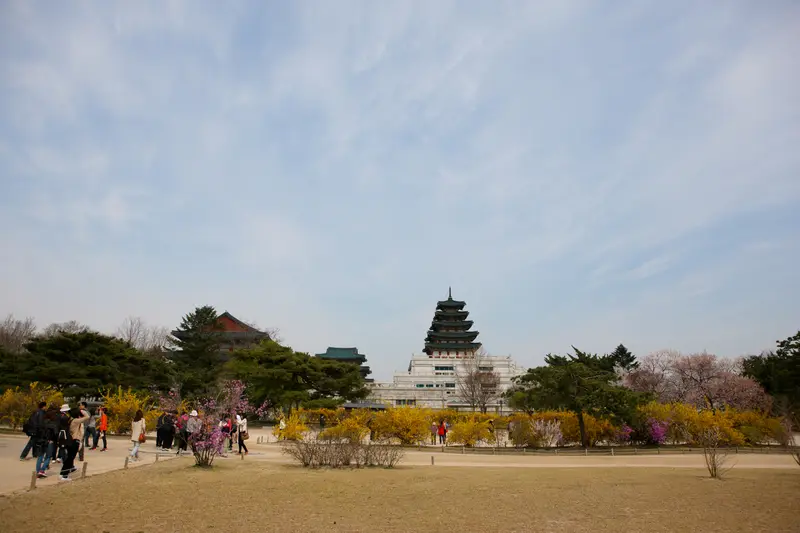
A free museum of everyday life and seasonal customs in Korea, at the palace's east edge with its main gate on Samcheong-ro. It is about 15 minutes from Exit 1 of Anguk Station or 14 minutes from Exit 5 of Gyeongbokgung Station, so it suits a visit that continues to Bukchon and Samcheong-dong. Permanent Exhibition Hall 1 is closed until December 21, 2026 (planned), and on weekends and holidays access inside the outdoor exhibits is limited.
- Hours
- March to October 9:00 to 18:00 (Wednesdays until 20:00); November to February 9:00 to 17:00. Last entry 1 hour before closing
- Closed
- January 1, Lunar New Year's Day and Chuseok Day according to the museum. One recent blog post says it closes on Tuesdays, so check before you plan a Tuesday visit
- Admission
- Free
- English tours
- Monday and Friday 10:30 and 14:30, Wednesday 14:30, Thursday and Sunday 10:30. Meet at the 1st-floor lobby information desk of the main building. Free, no sign-up
Foreigner access
- Korean name
- 국립민속박물관
- Booking
- No booking for individual visitors; join tours on the spot
- English
- Signs: unconfirmed · Staff: unconfirmed
English tours run at least six times a week, and the museum offers an English information guide.
Jijibaebae Hanbok (Gyeongbokgung)
A hanbok rental shop on the 3rd floor at 18 Jahamun-ro 2-gil, 2 minutes from Exit 3 of Gyeongbokgung Station, among the cheapest of the shops listed here.
- Hours
- 9:00 to 19:00, daily
- Prices
- Traditional hanbok 15,000 won for 2 hours, 20,000 won for 4 hours, 30,000 won for the day. Special, character and pleated-skirt styles 20,000 to 50,000 won
Foreigner access
- Korean name
- 지지배배한복 경복궁점
- Booking
- Listed on Naver Booking (requires a Naver login). Whether walk-ins are accepted is unconfirmed
Korean phone number needed: unconfirmed - English
- Signs: unconfirmed · Staff: unconfirmed
- Queue app
- unconfirmed
Hanbok Sonyeo
A hanbok rental shop on the 2nd floor at 8 Jahamun-ro 2-gil, 1 minute from Exit 3-1 of Gyeongbokgung Station. Closed on Tuesdays, like the palace.
- Hours
- 9:00 to 19:00, closed on Tuesdays
- Prices
- Standard hanbok 15,000 won for 2 hours, 25,000 won for 4 hours, 35,000 won for the day. Fusion, premium and luxury styles 20,000 to 60,000 won
Foreigner access
- Korean name
- 한복소녀
- Booking
- Listed on Naver Booking (requires a Naver login). Whether walk-ins are accepted is unconfirmed
Korean phone number needed: unconfirmed - English
- Signs: unconfirmed · Staff: unconfirmed
- Queue app
- unconfirmed
Ari Hanbok
A higher-priced hanbok rental shop on the 3rd floor at 20 Jahamun-ro, 3 minutes from Exit 3 of Gyeongbokgung Station, with premium and signature outfits for photos. Closed on Tuesdays.
- Hours
- 10:00 to 20:00, closed on Tuesdays
- Prices
- 2 hours: traditional 40,000 won, premium 60,000 won, signature 90,000 won. A recent visitor's price list gives traditional 45,000 won for 4 hours and 100,000 won for the day
Foreigner access
- Korean name
- 아리한복
- Booking
- Listed on Naver Booking (requires a Naver login). A recent visitor booked before going; whether walk-ins are accepted is unconfirmed
Korean phone number needed: unconfirmed - English
- Signs: unconfirmed · Staff: unconfirmed
- Queue app
- unconfirmed
Hanboknam (Gyeongbokgung)
A hanbok rental shop at 133-5 Sajik-ro, 1 minute from Exit 4 of Gyeongbokgung Station. Prices are listed as ranges only, so ask for the price of the time you want.
- Hours
- 9:00 to 19:00, daily
- Prices
- Traditional hanbok 10,000 to 30,000 won (from 1 hour 30 minutes to the full day), theme hanbok 20,000 to 50,000 won, according to its Naver listing
Foreigner access
- Korean name
- 한복남 경복궁점
- Booking
- Listed on Naver Booking (requires a Naver login). Whether walk-ins are accepted is unconfirmed
Korean phone number needed: unconfirmed - English
- Signs: unconfirmed · Staff: unconfirmed
- Queue app
- unconfirmed
Hotels
Experiences
Sources
- Royal Palaces and Tombs Center: viewing hours (Korean)(accessed 2026-11-10)
- Royal Palaces and Tombs Center: Gyeongbokgung admission fees and passes (Korean)(accessed 2026-11-10)
- Royal Palaces and Tombs Center: free admission in hanbok, guidelines and Q&A (Korean)(accessed 2026-11-10)
- Royal Palaces and Tombs Center: Gyeongbokgung guided tours (Korean)(accessed 2026-11-10)
- Royal Palaces and Tombs Center: directions to Gyeongbokgung (Korean)(accessed 2026-11-10)
- Royal Palaces and Tombs Center: Gyeongbokgung walking courses (Korean)(accessed 2026-11-10)
- Royal Palaces and Tombs Center: reservations list for Gyeongbokgung (Korean)(accessed 2026-11-10)
- Royal Palaces and Tombs Center: Gyeongbokgung history (Korean)(accessed 2026-11-10)
- Royal Palaces and Tombs Center: Gyeongbokgung Palace and Its History (English)(accessed 2026-11-10)
- Royal Palaces and Tombs Center: Gyeongbokgung FAQ (Korean)(accessed 2026-11-10)
- Notice: Gyeongbokgung night viewing, second half of 2026 (Korean)(accessed 2026-11-10)
- Notice: Gyeongbokgung night viewing, first half of 2026 (Korean)(accessed 2026-11-10)
- Notice: Gyeonghoeru and Hyangwonjeong special tours 2026 (Korean)(accessed 2026-11-10)
- Notice: Geunjeongjeon terrace access restricted, September to October 2026 (Korean)(accessed 2026-11-10)
- Notice: Gyeongbokgung opening on exam day, November 2025 (Korean)(accessed 2026-11-10)
- Notice: guard ceremony suspended during heat wave warnings, with programme times (Korean)(accessed 2026-11-10)
- Notice: Gyeongbokgung opening, October to November 2026 (Korean)(accessed 2026-11-10)
- Korea Heritage Service: Geunjeongjeon Hall, National Treasure (Korean)(accessed 2026-11-10)
- Korea Heritage Service: Gyeonghoeru Pavilion, National Treasure (Korean)(accessed 2026-11-10)
- Korea Heritage Service: Hyangwonjeong Pavilion, Treasure (Korean)(accessed 2026-11-10)
- Korea Heritage Foundation: Royal Guard Changing Ceremony programme (Korean)(accessed 2026-11-10)
- Korea Heritage Foundation: Royal Guard Changing Ceremony visitor information (Korean)(accessed 2026-11-10)
- Korea Heritage Foundation: Royal Guard Changing Ceremony procedure (Korean)(accessed 2026-11-10)
- National Palace Museum of Korea: visitor information (Korean)(accessed 2026-11-10)
- National Palace Museum of Korea: directions (Korean)(accessed 2026-11-10)
- National Folk Museum of Korea: visitor information (Korean)(accessed 2026-11-10)
- National Folk Museum of Korea: directions (Korean)(accessed 2026-11-10)
- Naver Place business listings (hours, prices, station exits) for each place(accessed 2026-11-10)
- Naver blog: Ari Hanbok price list (November 2026)(accessed 2026-11-10)
- Naver blog: Gyeongbokgung autumn ginkgo on Hyoja-ro (November 2026)(accessed 2026-11-10)
- Naver blog: autumn leaves from Hyangwonjeong to Gyeonghoeru (November 2026)(accessed 2026-11-10)
- Naver blog: National Folk Museum closing day claim (November 2026)(accessed 2026-11-10)