Jeju's Oreum and Forests: Saebyeol, Darangshi, Saryeoni and More
Small volcanic cones and cedar forests between the coast and Hallasan, with buses, times, fees and closures
Intro
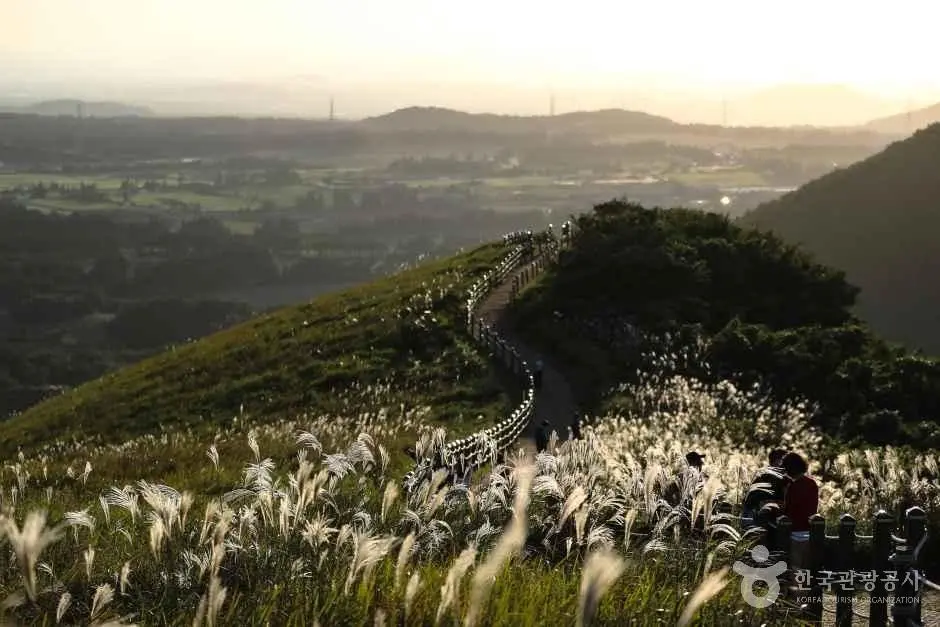
Oreum is the Jeju word for the small volcanic cones that dot the island, more than 360 of them, scattered over the open grassland between the coast and Hallasan. Most are under an hour to climb, many need no ticket, and from the top of one you look across at others standing in the fields around it. Between them grow forests: the tall cedar plantations of Saryeoni and Jeolmul, and gotjawal, the tangled woodland that grows over broken lava. Korean travellers come for the silver grass on the oreum in October and November, for sunsets from the western cones, and for a walk under the cedars when it rains.
This page picks the oreum and forests worth a trip, grouped into three areas. The east, around Songdang, has the most famous cones close together, and the 810 tourist bus loops past most of them. The west has Saebyeol Oreum by a main bus road and two gotjawal forests near Jeju English Education City. In the centre, Saryeoni Forest Path and Jeolmul Natural Recreation Forest are under an hour by bus from Jeju City. For the summit of Hallasan itself, see Hallasan; for the cone at the east tip of the island, Seongsan Ilchulbong.
Which to choose
- One oreum, no car: Saebyeol Oreum in the west (bus stop at the foot) or Yongnuni Oreum in the east (810 bus stop at the foot, 15 minutes to the top).
- The most striking eastern cone: Darangshi Oreum, steep, with a round crater 115 m deep.
- The easiest walk: Abu Oreum, 10 to 20 minutes to the rim, with the ring of cedars inside.
- Silver grass in October and November: Saebyeol, Ttarabi, Darangshi and Akkeun Darangshi beside it, Yongnuni.
- Sunset: Saebyeol Oreum and Geumoreum, both facing the west coast.
- A forest walk on a rainy or hot day: Jeolmul Natural Recreation Forest (gentle paths, one bus from the airport) or Saryeoni Forest Path (longer, start in the morning).
- UNESCO World Heritage: Geomunoreum, with walks you book from the 1st of the previous month.
A day on the 810 tourist bus
The 810 loop starts and ends at the Daecheon transfer stop (대천환승정류장), 40 to 47 minutes from Jeju Bus Terminal on Bus 211 or 212. The 810-1 runs every hour and takes about an hour for the loop, so you can get off, climb, and catch the next one. Times below are 810-1 departures from Daecheon.
- Morning: take the 9:10 or 10:10 810-1 from Daecheon (or board it at Jeju Airport at 8:20 or 9:20). Get off at Abu Oreum (5 minutes) for the easy crater walk.
- Late morning: the next 810-1 to Yongnuni Oreum (14 minutes from Daecheon). Climb to the three craters and look across to Seongsan Ilchulbong.
- Early afternoon: on to the Darangshi Oreum (north) stop and walk about 24 minutes to the entrance, or skip ahead to Bijarim Forest (23 minutes from Daecheon) for the nutmeg trees.
- Afternoon: the 810-1 continues past Dongbaek Dongsan (42 minutes) to the World Natural Heritage Center for Geomunoreum, if you have a booking, and back to Daecheon. The last 810-1 leaves Daecheon at 18:00; from Daecheon, buses 211 and 212 run back to Jeju Bus Terminal until after 22:00.
Baekyakyi and Ttarabi have no toilets.
Sights
West: Saebyeol, Geumoreum and the gotjawal
Saebyeol Oreum is the oreum most Korean visitors know, a grassy cone of five peaks that turns silver with grass in October. The path to the 519.3 m top takes 20 to 30 minutes and is steep in places; the view takes in the west coast and Biyangdo. Each March it is the site of the Jeju Fire Festival, which once set the whole hillside alight: since 2025 the hillside burning has been digital, with a daljip (straw moon house) bonfire and performances. In 2026 the festival ran from March 9 to 14. Buses on the Pyeonghwa-ro stop about 2 minutes from the foot.
Geumoreum in Hallim has a round crater 52 m deep at the top, with a crater pond whose bed is now mostly dry. It faces the sea to the west, which makes it a sunset spot, but buses are few: Bus 783-1 runs three times a day from Donggwang and four from Hallim. Come by taxi or car, and bring a torch if you stay for the sunset.
Jeju Gotjawal Provincial Park and Hwansang Forest Gotjawal Park are two ways into gotjawal, the forest over lava that is unique to Jeju. The provincial park is larger, with five trails and an observation tower, and costs 1,000 won; wear proper walking shoes or you will be turned away. Hwansang Forest is a small forest with a guided walk on the hour (book ahead on Naver Booking or by phone) and a footbath; it closes on Sundays.
East: the Songdang oreum, Geomunoreum and Dongbaek Dongsan
Songdang has many of the best-known oreum close together, and the 810 bus runs past them.
Darangshi Oreum is a steep cone seen from all over Songdang, with a deep, round crater at the top; give it 30 to 40 minutes up and more if you walk the rim. Its smaller neighbour, Akkeun Darangshi, is known for silver grass. Yongnuni Oreum is the gentle one, all soft ridges and three craters, 15 minutes to the top; it reopened in 2023 after more than two years closed for rest. Abu Oreum is the shortest walk, to a rim looking down on a ring of cedars. Baekyakyi Oreum, south of Abu, is named for its medicinal herbs, but its summit is closed for rest, so you can only walk the lower paths.
Ttarabi Oreum, further south in Gasi-ri, has three craters and six peaks and some of the best silver grass in October and November, but no bus: take a taxi or drive.
Geomunoreum is different from the others: it is part of the UNESCO World Natural Heritage site, and walks are by booking only, opening at 9:00 on the 1st of the previous month. Booking is online with a login or by phone, and the confirmation is sent by KakaoTalk or text, so it may require a Korean phone number. The phone line is 064-710-8980. It is closed on Tuesdays. The lava that flowed from here formed the Manjanggul lava tube on the East Jeju coast.
Dongbaek Dongsan, near Geomunoreum, is a free evergreen forest with wetland ponds and a Ramsar listing. Bijarim Forest, the old nutmeg forest, is also on the 810 loop; it is covered in more detail on East Jeju.
Central: Saryeoni and Jeolmul
Saryeoni Forest Path is about 10 km of forest path under tall cedars, from Bijarim-ro to the Red Oreum entrance on Namjo-ro. Most walkers get off Bus 231 or 232 at the Namjo-ro end, where the paths of red scoria are, and walk in and back, about 2 to 2.5 hours. The path is open from 9:00 to 17:00, but entry can be stopped from early afternoon (from noon in winter), so start in the morning. It can close in heavy rain or snow. No food is allowed on the path. Mulchat Oreum, partway along, is closed for rest.
Jeolmul Natural Recreation Forest is the easy forest walk, under an hour by Bus 43 from the airport. The cedar paths are gentle, some are step-free, and the climb to the lookout on Jeolmul Oreum takes about an hour there and back. It opens at 7:00, earlier than most sights. It also has cabins, booked on the Supnadeuri-e forest site.
Rules and closures
- Some oreum are closed for rest. Jeju closes some oreum, or parts of them, to let the ground recover. Right now these include the summit of Baekyakyi Oreum and Mulchat Oreum on the Saryeoni path; Songaksan’s summit on the south coast is also closed. Closures change, so check before you go, and do not enter fenced or signed areas.
- Private land. Many oreum are on private or village land. Jeju lists the oreum with marked trails, but a marked trail does not mean you may cross the land around it: do not climb over closed gates, fences or no-entry signs.
- Finding them. Oreum addresses are often plain land parcel numbers, so search the Korean name (given on each card) in Naver Map or Google Maps, and many have no car park. The Jeju Tourist Information Center (064-740-6000) can answer questions.
- Weather. Saryeoni and Geomunoreum close partly or fully in bad weather. Darangshi’s slopes are steep, and Visit Jeju warns of snakes and ticks on Saebyeol.
- Food and pets. No food on the Saryeoni path or Geomunoreum. Dogs on a lead are allowed on Saebyeol, Abu and Baekyakyi but not on Darangshi.
When to go
- October and November for silver grass on Saebyeol, Ttarabi, Darangshi and the eastern cones.
- March for the Jeju Fire Festival at Saebyeol Oreum (2027 dates have not been announced).
- Morning for Saryeoni (entry can be stopped from noon in winter), Geomunoreum (the last walk starts at 14:00) and anything on the 810 bus, which stops at 18:00.
- Late afternoon for sunset from Saebyeol Oreum or Geumoreum.
- Rainy or very hot days: the cedar forests. Visit Jeju describes Jeolmul as worth seeing in mist and rain, and Saryeoni as shady even in summer.
- Closing days to note: Tuesdays (Geomunoreum), Sundays (Hwansang Forest), Mondays for the Saebyeol guide talks.
Getting there
- Paying: city and local buses, including the tourist circulation buses, cost 1,150 won a ride with a transit card such as T-money; express buses (131, 132 and 151 on this page) cost 2,000 to 3,000 won by distance. Jeju buses do not take cash. See How to Get to Jeju and Around the Island for cards and fares.
- East oreum: Bus 211 or 212 from Jeju Bus Terminal to Daecheon (40 to 47 minutes), then the 810 tourist bus loop. The first two 810-1 runs start at Jeju Airport (8:20 and 9:20). Nine 211 and 212 runs a day go along Geumbaekjo-ro past Abu and Baekyakyi Oreum.
- Saryeoni: Bus 231 or 232 from Jeju Bus Terminal, 23 a day, to the 남조로 사려니숲길 stop at the Namjo-ro entrance. Bus 212 serves the Bijarim-ro entrance.
- Jeolmul: Bus 43-1, 43-2 or 43-3 from Jeju Airport, 55 to 65 minutes.
- Saebyeol Oreum: buses 251 to 255 and 282 from Jeju Bus Terminal along the Pyeonghwa-ro; not every run stops at the Saebyeol Oreum stop.
- West forests: Bus 255 or Express Bus 151 to English Education City for the provincial park; Bus 784-1 or the 820 tourist bus for Hwansang Forest.
- Taxi or car: Ttarabi Oreum (no bus) and Geumoreum (three buses a day from Donggwang, four from Hallim).
- Timetables: the timetables used here took effect between 2019 and 2026. Check the day’s times in Google Maps or on the Jeju Bus Information System; the tourist buses and the rural routes can be an hour or more apart.
Common questions
- What is an oreum? A small volcanic cone, the Jeju word for the more than 360 that stand around the island. The ones on this page take 10 to 40 minutes to the top.
- Which oreum can I reach by bus? Saebyeol (Pyeonghwa-ro buses) in the west, and Abu, Yongnuni, Darangshi and Geomunoreum on the 810 tourist bus in the east. Ttarabi has no bus.
- What time does Saryeoni Forest Path close? It is open from 9:00 to 17:00, but entry can be stopped from early afternoon, from noon in winter. Go in the morning.
- Do I need to book Geomunoreum? Yes. Bookings open at 9:00 on the 1st of the previous month and close at 17:00 the day before. The confirmation comes by KakaoTalk or text, so it may require a Korean phone number. Closed Tuesdays.
- Can I climb to the top of Baekyakyi Oreum? Not now: the summit is closed for rest. The lower paths are open.
- Is Yongnuni Oreum open? Yes, since July 1, 2023. Stay on the marked path.
- When is the silver grass season? October and November.
Nearby
- East Jeju: Hamdeok, Woljeong-ri and Sehwa for the coast below the eastern oreum, Bijarim Forest and the Manjanggul lava tube.
- Aewol, the coast below Saebyeol Oreum.
- Hallasan for the trails up Jeju’s mountain.
- Seongsan Ilchulbong, the crater cone at the east end of the island. Back to the Jeju guide.
Hours & Fees
- Tourist circulation Bus 810 (east)
- 1,150 won. A loop from the Daecheon transfer stop (대천환승정류장) past Abu, Darangshi, Yongnuni, Bijarim, Dongbaek Dongsan and Geomunoreum, about 60 minutes round. 810-1 leaves Daecheon every hour from 9:10 to 18:00 (10 a day; the first two start at Jeju Airport at 8:20 and 9:20). 810-2 runs the other way at 9:30, 11:30, 13:30, 15:30 and 17:00; the 17:00 run goes on to Jeju Bus Terminal (18:40) and the airport (18:50)
- Buses 211 and 212 (to Daecheon and Songdang)
- 1,150 won. Jeju Bus Terminal to Daecheon-dong in 40 to 47 minutes, 27 a day from 6:05 to 21:40. Nine of them run via Geumbaekjo-ro past Abu Oreum and Baekyakyi Oreum (from the terminal at 6:05, 7:45, 9:30, 11:25, 13:25, 15:10, 16:55, 18:43 and 20:15)
- Buses 231 and 232 (Saryeoni, Namjo-ro side)
- 1,150 won. Jeju Bus Terminal 6:00 to 21:25, 23 a day, to the 남조로 사려니숲길 stop on Namjo-ro
- Buses 43-1, 43-2 and 43-3 (Jeolmul)
- 1,150 won. Jeju Airport to Jeolmul Natural Recreation Forest in 55 to 65 minutes, 22 a day (19 from November to February). The last bus back leaves Jeolmul at 20:55, or 18:50 from November to February
- Pyeonghwa-ro buses (Saebyeol Oreum)
- 1,150 won. Buses 251 to 254, 255 and 282 from Jeju Bus Terminal along the Pyeonghwa-ro road; buses 251 to 254 alone run 56 times a day from 5:50 to 21:35. Not every run stops at the Saebyeol Oreum stop
- Tourist circulation Bus 820 (west)
- 1,150 won. A loop from Donggwang transfer stop past O'sulloc and Hwansang Forest: 820-2 every hour or so from 9:10 to 17:30 (14 minutes to Hwansang Forest; the first two start at Jeju Airport at 8:20 and 9:20), and 820-1 the other way from 9:00 to 17:00 (46 minutes to Hwansang Forest)
Places by area
West (Aewol, Hallim and Daejeong)
Saebyeol Oreum
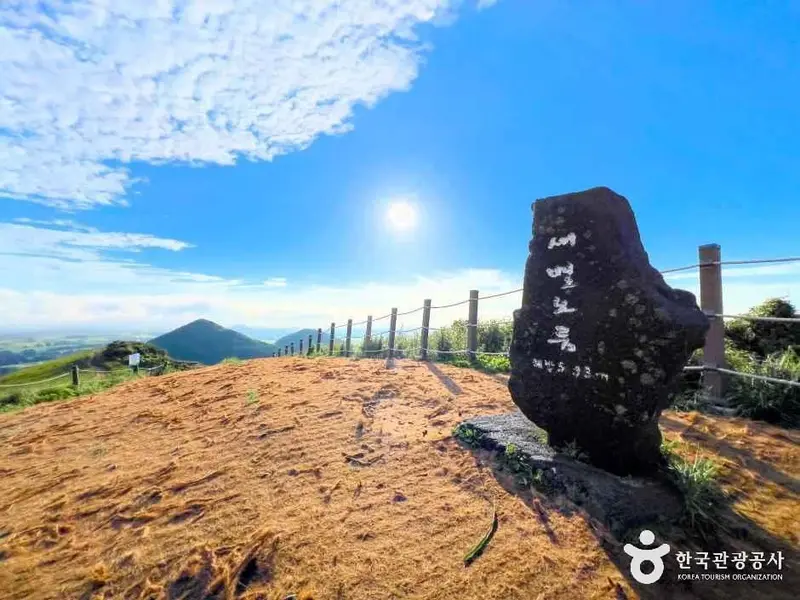
The best-known oreum in the west, a grassy cone of five peaks covered in silver grass in autumn. The top, at 519.3 m, takes about 20 to 30 minutes by a path with some steep stretches, and on a clear day it looks over the west coast to the island of Biyangdo; it is a sunset spot. The Jeju Fire Festival is held here each March. The bus stops about 2 minutes from the foot, which makes it the easiest oreum to reach without a car.
Featured on Korea Forest Service (YouTube)
- Hours
- Open at all times, all year
- Admission
- Free. Free car park at the entrance
- Climb
- About 20 to 30 minutes to the top. There are two entrances; the western path is steeper
- Guide
- A culture and tourism guide gives a 15 to 20 minute talk at 10:30, 13:30 and 15:00, except Mondays, Seollal and Chuseok; book on 064-728-2754 or sign up on the spot. Whether it is given in English is not confirmed
- Rules
- Dogs allowed on a lead of 2 m or less; pick up after them. Watch for snakes and ticks. No horse riding
- Getting there
- Bus stop 새별오름, about 2 minutes on foot: buses 251, 252, 253, 254, 255 and 282 on the Pyeonghwa-ro (1,150 won). On the timetable, buses 251 to 254 reach the Driver's License Test Center stop (운전면허시험장) 31 to 37 minutes from Jeju Bus Terminal, and Saebyeol Oreum is a few stops further. Not every run stops there, so check the next bus in Naver Map or Google Maps
Foreigner access
- Korean name
- 새별오름
Foreigner access details not yet confirmed
Geumoreum
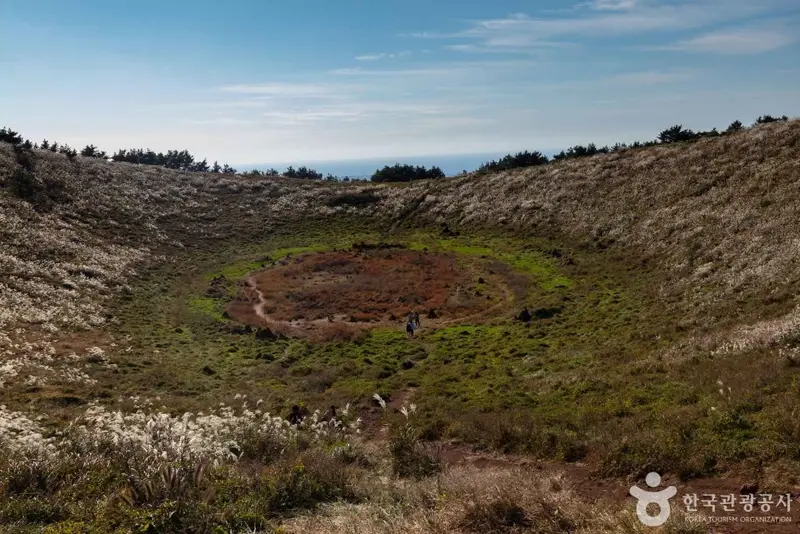
A twin-peaked oreum in Hallim with a round crater 52 m deep at the top and a crater pond, Geumakdam, whose bed is now mostly dry and open to view. The name comes from an old word for a god. It is a sunset spot looking west to the sea. The walk up from the car park is a steep paved slope, about 15 to 20 minutes, and cars cannot drive to the top. Buses are rare, so most visitors come by car or taxi.
- Hours
- Open at all times, all year
- Admission
- Free
- Climb
- About 15 to 20 minutes from the car park on a steep paved road, according to a November 2026 blog post. There are no lights on the top, so bring a torch if you stay for the sunset
- Getting there
- Bus stop 금오름[남], about 4 minutes on foot: Bus 783-1 only: 3 runs a day from Donggwang (7:40, 10:28 and 14:30) and 4 from Hallim (6:38, 9:30, 11:26 and 15:40). In practice, a taxi or car
Foreigner access
- Korean name
- 금오름
Foreigner access details not yet confirmed
Jeju Gotjawal Provincial Park
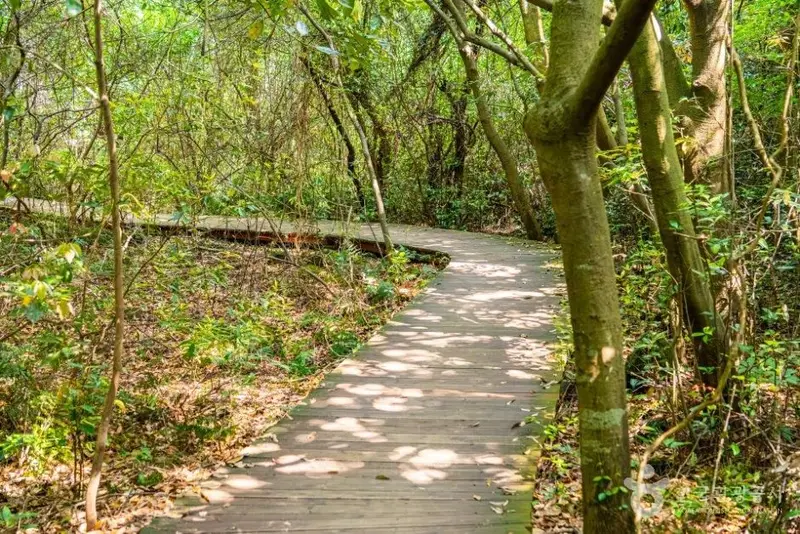
A public park for walking in gotjawal, the forest that grows over broken lava on Jeju. Five marked trails run through it, with an observation tower where three of them meet, and forest guides lead walks twice a day. The visitor centre at the entrance has exhibitions and a cafe. Proper walking shoes are required. It is by Jeju English Education City in Daejeong, a short walk from the bus stop.
- Hours
- March to October: enter 9:00 to 16:30, leave by 18:00. November to February: enter 9:00 to 15:00, leave by 17:30. Open all year
- Admission
- Adults 1,000 won, teenagers and soldiers 800 won, children 500 won
- Rules
- Hiking boots or trainers required; no dress shoes, sandals or platform trainers
- Getting there
- Bus stop 삼정지에듀/곶자왈도립공원, about 7 minutes on foot: Bus 255 from Jeju Bus Terminal (about 57 minutes to English Education City, 19 a day) and Express Bus 151 from Jeju Airport. Bus 751-2 stops right outside, a few times a day
Foreigner access
- Korean name
- 제주곶자왈도립공원
- Booking
- No booking; buy tickets on site
- English
- Signs: unconfirmed · Staff: unconfirmed
Hwansang Forest Gotjawal Park
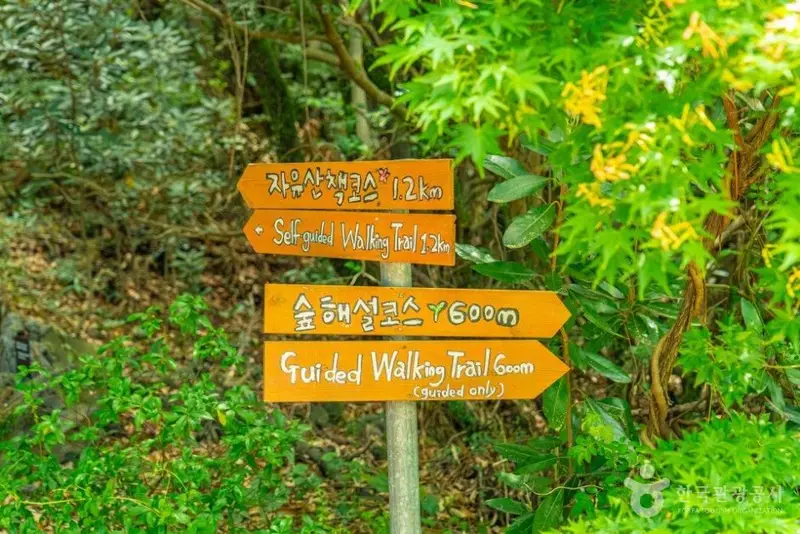
A small gotjawal forest at the end of a lava flow from Doneori Oreum, where plants of northern and southern climates grow side by side. Guides lead a walk on the hour, and you can also walk the trail on your own; a footbath session costs extra. A 2015 music video by the K-pop group f(x) was filmed here. Buses stop at the gate.
- Hours
- 9:00 to about 17:00, closed Sundays
- Admission
- Adults (from middle school) 5,000 won; children 4,000 won. Footbath 12,000 won
- Guided walk
- On the hour from 9:00 to 17:00 (last at 16:00 in winter and in bad weather). Book ahead on Naver Booking or by phone (064-772-2488). The self-guided trail needs no booking
- Getting there
- Bus stop 환상숲곶자왈공원, about 1 minute on foot: Bus 784-1 (10 a day from Donggwang, 6:40 to 20:00) and the 820 tourist buses (1,150 won). On 820-2 it is 14 minutes from Donggwang transfer stop
Foreigner access
- Korean name
- 환상숲곶자왈공원
- Booking
- Guided walk: Naver Booking (requires a Naver login) or phone. Self-guided walk: buy tickets on site
Korean phone number needed: unconfirmed - English
- Signs: Partly · Staff: unconfirmed
East (Songdang, Gujwa and Seonheul)
Darangshi Oreum
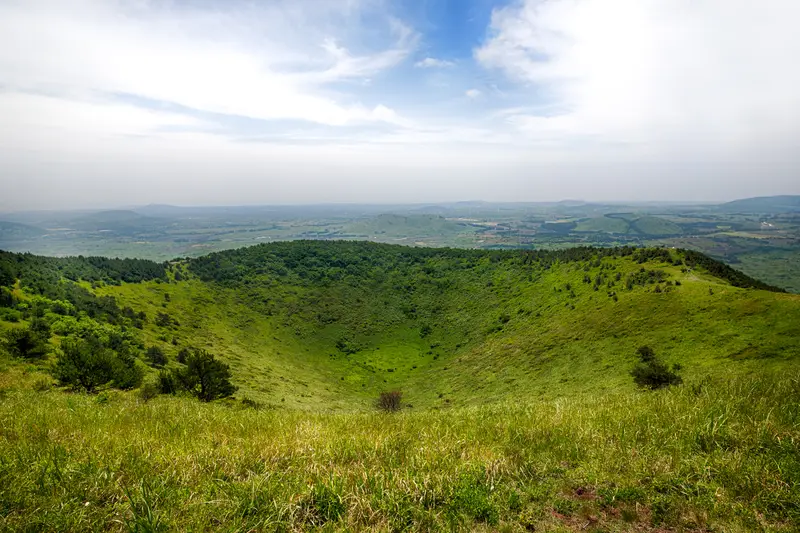
Called the queen of the oreum for its tall, even shape, seen from all over Songdang. At the top is a round, funnel-shaped crater about 1.5 km around and 115 m deep, said to be as deep as Baengnokdam on Hallasan. Every side is steep: allow 30 to 40 minutes to the top and an hour or more with the crater rim. Its small neighbour, Akkeun Darangshi, is known for silver grass. Darangshi village at its foot was destroyed during the Jeju April 3 Incident, and in 1992 the remains of 11 villagers who had hidden in a nearby cave were found.
Featured on KBS, Mountain Album (YouTube)
- Hours
- Open at all times, all year
- Admission
- No fee listed
- Climb
- About 30 to 40 minutes to the top, 1 to 1.5 hours with the crater rim, according to recent blog posts. The slopes are steep on every side
- Rules
- No pets on the oreum; dogs on a lead with bags are allowed on the path around the foot
- Getting there
- Bus stop 다랑쉬오름입구(북), about 24 minutes on foot (1.4 km) to the visitor centre at the entrance: tourist buses 810-1 (20 minutes from Daecheon) and 810-2 (40 minutes from Daecheon), 1,150 won. Or a taxi from Songdang
Foreigner access
- Korean name
- 다랑쉬오름
Foreigner access details not yet confirmed
Yongnuni Oreum
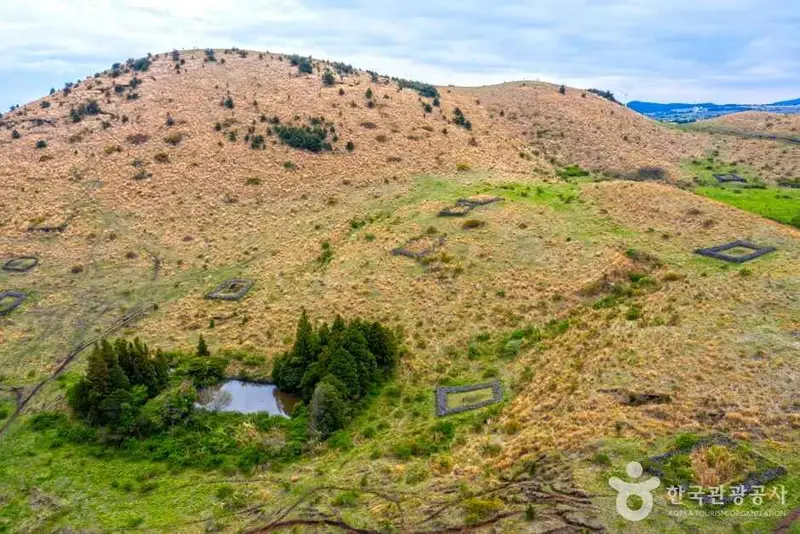
A low oreum of soft, curving ridges and the only one of Jeju's more than 360 with three craters. The top is 15 minutes up a gentle slope, and a loop around the three craters takes about an hour. On a clear day you can see Seongsan Ilchulbong, Udo, Darangshi and Jimibong. It was loved by the photographer Kim Young-gap. Grass covers it in spring and summer, silver grass in autumn and winter. It was closed for rest from February 2021 and reopened on July 1, 2023.
- Hours
- Open at all times, all year. Parts of the slope may still be closed for restoration; stay on the marked path and check before you go
- Admission
- No fee listed
- Climb
- 15 minutes to the top; about 1 hour around the three craters
- Getting there
- Bus stop 용눈이오름, about 1 minute on foot: tourist buses 810-1 (14 minutes from Daecheon) and 810-2 (46 minutes), 1,150 won
Foreigner access
- Korean name
- 용눈이오름
Foreigner access details not yet confirmed
Abu Oreum
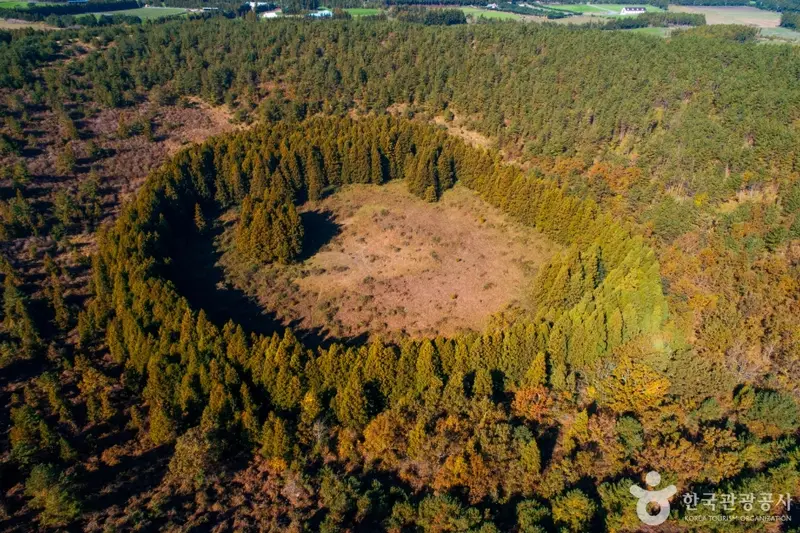
The easiest oreum on this page: gentle slopes all round, and about 10 to 20 minutes to the crater rim. Inside the crater, 78 m deep and about 1.4 km around the rim, a ring of planted cedar trees circles the grassy floor. The name means front hill, from its place south of Songdang village. The tourist bus stops at the car park.
- Hours
- Open all year. Parts of it can be closed; check before you go
- Admission
- Free; free car park at the entrance
- Climb
- About 10 to 20 minutes to the rim; 40 minutes to an hour with the walk round, according to recent blog posts
- Rules
- Dogs allowed on a lead of 2 m or less; bring bags
- Getting there
- Bus stop 아부오름 주차장, about 1 minute on foot: tourist buses 810-1 (5 minutes from Daecheon) and 810-2 (55 minutes). Bus stop 아부오름, about 8 minutes on foot: the Geumbaekjo-ro runs of buses 211 and 212 from Jeju Bus Terminal, and Bus 721-2 (1,150 won)
Foreigner access
- Korean name
- 아부오름
Foreigner access details not yet confirmed
Baekyakyi Oreum
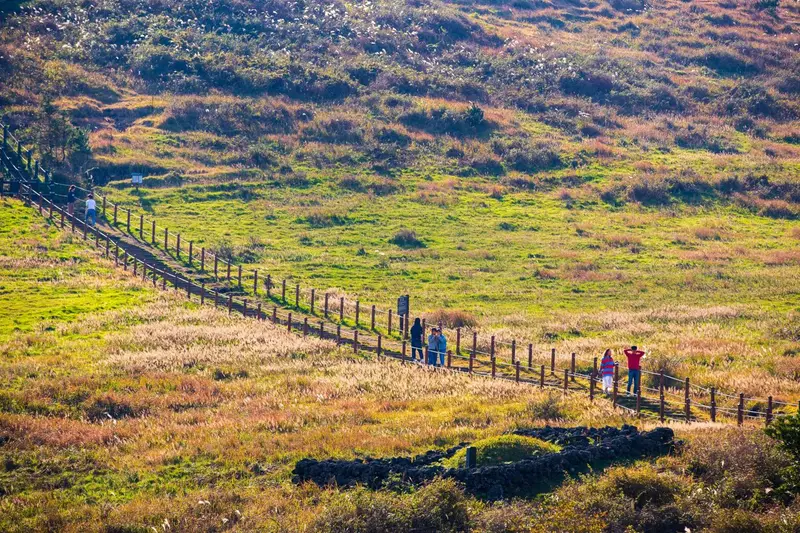
An oreum named for the many medicinal herbs that grow on it, with a wide, round crater at the top. The summit and the walk around its crater are closed for rest; the lower paths are open, about 30 to 40 minutes there and back. There are no toilets or visitor centre. Buses stop at the foot.
- Hours
- Open at all times, except the summit, which is closed for rest; check before you go
- Admission
- No fee listed
- Climb
- About 30 to 40 minutes there and back on the open paths. No toilets
- Getting there
- Bus stop 백약이오름, about 1 minute on foot: the Geumbaekjo-ro runs of buses 211 and 212 from Jeju Bus Terminal (9 a day) and Bus 721-2 (1,150 won). The 810 tourist buses do not stop here
Foreigner access
- Korean name
- 백약이오름
Foreigner access details not yet confirmed
Ttarabi Oreum
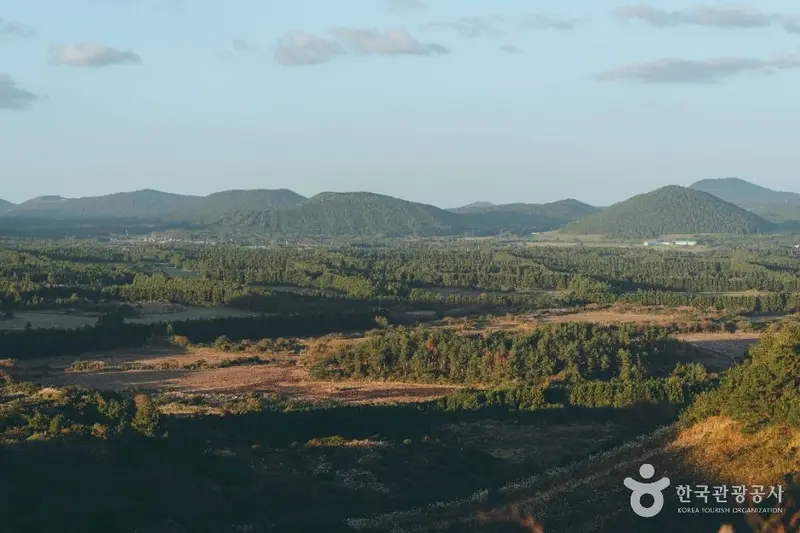
An oreum of three craters and six peaks in Gasi-ri, south of the Songdang group, also called a queen of the oreum for its silver grass, which is at its fullest in October and November. The top is about 20 to 30 minutes up a stepped path, and from it you look across to Keunsaseumi Oreum and a wind farm; the walk around the craters takes 1 to 1.5 hours there and back. There are no toilets, and no bus stop nearby.
- Hours
- Open at all times, all year
- Admission
- No fee listed
- Climb
- About 20 to 30 minutes to the top; 1 to 1.5 hours around the craters. No toilets
- Getting there
- No bus stop nearby; taxi or car only
Foreigner access
- Korean name
- 따라비오름
Foreigner access details not yet confirmed
Geomunoreum
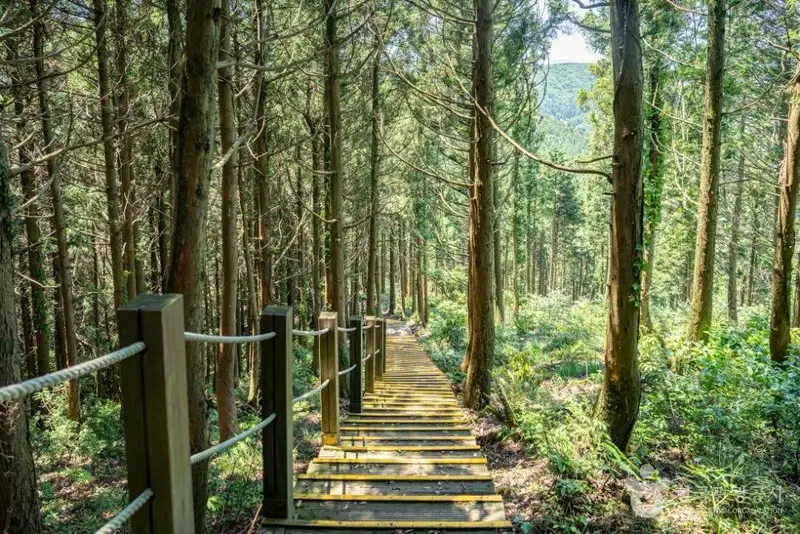
The only oreum in Jeju's UNESCO World Natural Heritage site. Lava from this 456 m cone flowed northeast to the coast and formed the Geomunoreum Lava Tube System, Manjanggul among it. The forest is so thick that the hill looks black, which gave it its name. Walks start from the World Natural Heritage Center and must be booked ahead: the summit course is about 2.1 km (about 1 hour) and the crater course about 5 km (about 2.5 hours), past lava landforms and Japanese wartime tunnels.
- Hours
- Walks start every 30 minutes from 9:00 to 14:00 (11 a day, 50 people each). The 13:30 and 14:00 starts cannot do the full course. Closed Tuesdays, Seollal and Chuseok, and closed entirely in bad weather
- Admission
- Adults 2,000 won; children, teenagers and soldiers 1,000 won; 6 and under and 65 and over free
- Booking
- Required. Online (after logging in to the World Natural Heritage Center site, as a member or a guest) or by phone (064-710-8980), from 9:00 on the 1st of the month before your visit until 17:00 the day before; no same-day bookings. Confirmation is sent by KakaoTalk or text message, so booking may require a Korean phone number. Arrive 10 minutes before your slot
- Rules
- No slippers or high heels. No food (sweets and chocolate allowed), no pets, and no toilets on the trail
- Getting there
- Bus stop 제주세계자연유산센터 거문오름, about 1 minute on foot: tourist bus 810-2, 5 minutes from Daecheon, and 810-1 at the end of its loop (1,150 won)
Foreigner access
- Korean name
- 거문오름
- Booking
- Required: online with a login (member or guest) or by phone, from the 1st of the previous month. Confirmation by KakaoTalk or text, so it may require a Korean phone number
Korean phone number needed: unconfirmed - English
- Signs: unconfirmed · Staff: unconfirmed
Dongbaek Dongsan
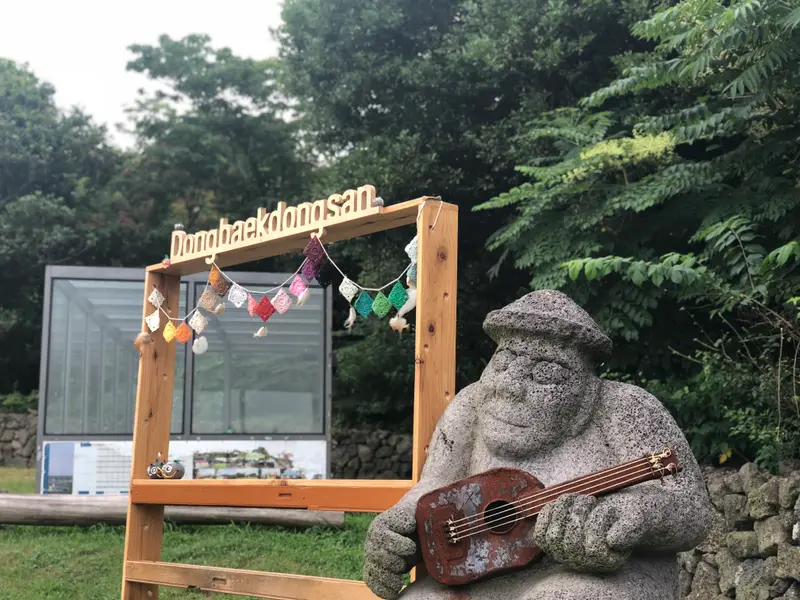
An evergreen gotjawal forest at Seonheul, the largest lowland warm-temperate evergreen forest on Jeju, named for its camellias (dongbaek), which villagers left standing when they cut wood because they sold the oil. Its wetland ponds sit on flat pahoehoe lava; the largest is Meonmulkkak. It was listed as a Ramsar wetland in 2011 and is a Jeju Global Geopark site. Free to enter, with the tourist bus stop at the wetland centre.
- Hours
- 9:00 to 18:00; closed on the days of Seollal and Chuseok
- Admission
- Free
- Getting there
- Bus stop 동백동산 습지센터, about 1 minute on foot: tourist buses 810-1 (42 minutes from Daecheon) and 810-2 (18 minutes). Or Bus 260 from Jeju Bus Terminal to 웃가름, about 15 minutes on foot (1,150 won)
Foreigner access
- Korean name
- 동백동산
Foreigner access details not yet confirmed
Bijarim Forest
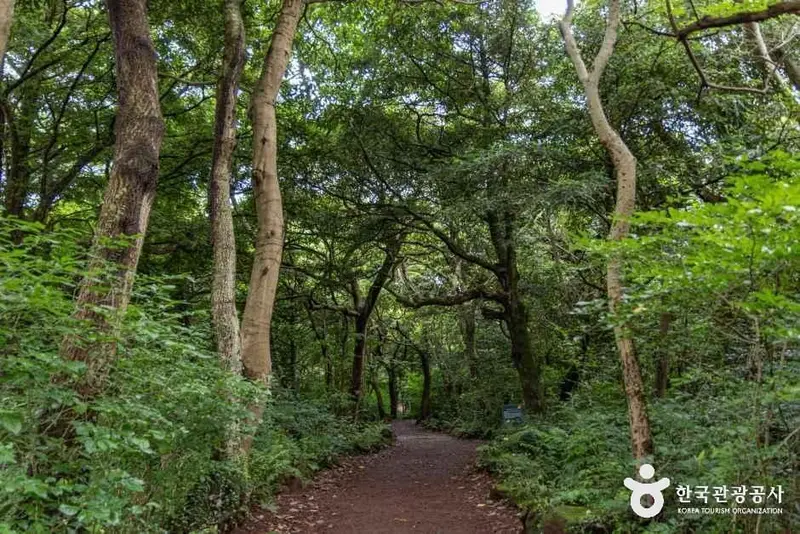
A forest of about 2,800 Japanese nutmeg trees (bija), 500 to 800 years old, a protected Natural Monument. The main loop is about 2.2 km, 40 minutes to an hour. It is also covered on the East Jeju page; here it is a stop on the 810 tourist bus loop.
- Hours
- 9:00 to 18:00 daily, last entry 17:00
- Admission
- Adults 3,000 won, children and teenagers 1,500 won
- Getting there
- Bus stop 비자림: tourist buses 810-1 (23 minutes from Daecheon) and 810-2 (37 minutes), and Bus 260 from Jeju Bus Terminal (1,150 won)
Foreigner access
- Korean name
- 비자림
- Booking
- No booking; buy tickets on site
- English
- Signs: unconfirmed · Staff: unconfirmed
Central (Gyorae and Bonggae)
Saryeoni Forest Path
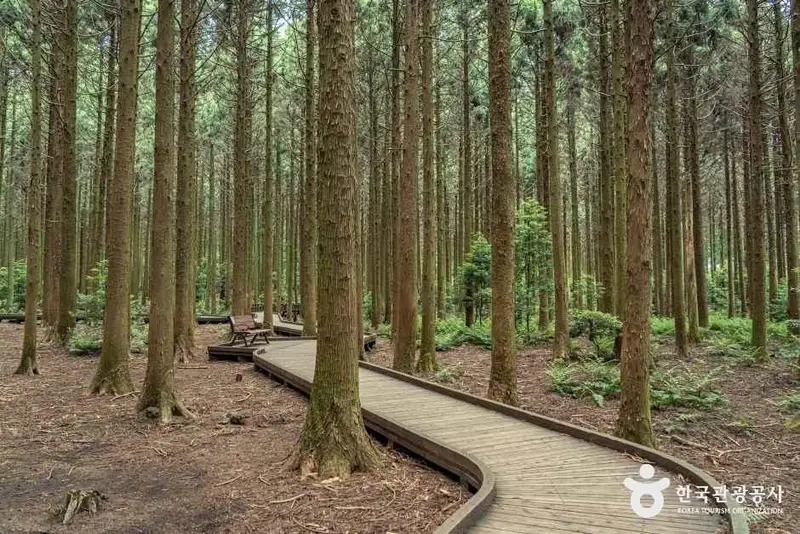
A forest path of about 10 km from Bijarim-ro, south of Jeolmul Oreum, past Mulchat Oreum to the Red Oreum (Bulgeun Oreum) entrance on Namjo-ro. Tall cedars line much of it, with oak, hornbeam and cypress, and the Red Oreum end has paths of red volcanic scoria. Saryeoni is said to mean a sacred place, and the area is part of the Jeju Biosphere Reserve. You do not have to walk all 10 km: most people go in from one entrance and turn back. Both entrances have bus stops.
Featured on Moheomga (YouTube)
- Hours
- Open 9:00 to 17:00; entry can be stopped from early afternoon (noon in winter), so start in the morning. Open all year, but parts or all of it can close in rain or heavy snow
- Admission
- Free; free parking at the Red Oreum entrance
- Walks
- From the Red Oreum (Namjo-ro) entrance to near the Mulchat Oreum turn-off and back: about 2 to 2.5 hours. From the Saryeoni car park via the Jeolmul bamboo path and the Bijarim-ro entrance to near Mulchat Oreum and back: about 3 to 3.5 hours. There is no parking at the Bijarim-ro entrance
- Rules
- No food; water is fine. Mulchat Oreum, off the path, is closed for rest except on event days with booking
- Getting there
- Namjo-ro side: bus stop 남조로 사려니숲길, about 1 minute on foot: buses 231 and 232 from Jeju Bus Terminal (1,150 won), and express buses 131 and 132 (2,000 to 3,000 won). Bijarim-ro side: bus stop 사려니숲길, about 2 minutes on foot: buses 212 and 232 (1,150 won)
Foreigner access
- Korean name
- 사려니숲길 붉은오름 입구
- Booking
- No booking for the path
- English
- Signs: unconfirmed
Jeolmul Natural Recreation Forest
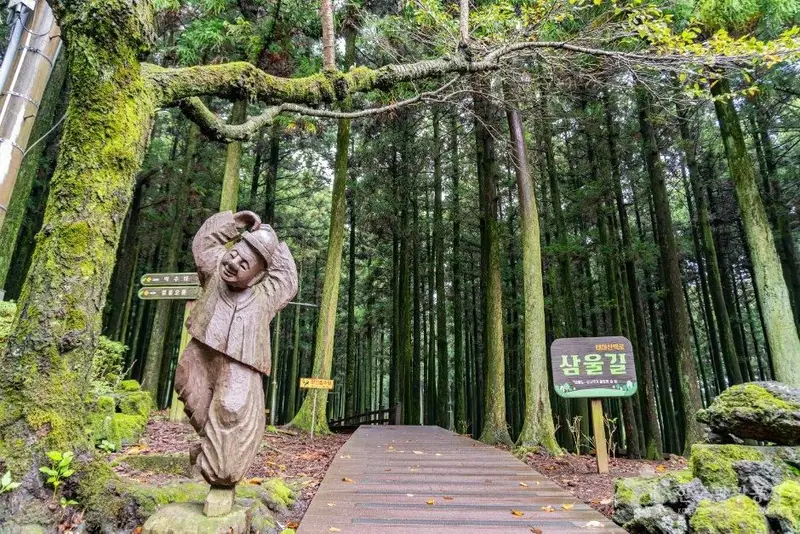
The nearest forest to Jeju City, a 300-hectare recreation forest of cedars planted from the 1960s, with natural woodland around it. Its walking paths are gentle, and some sections are step-free for wheelchairs and pushchairs. A climb up Jeolmul Oreum, about 697 m, to a lookout takes about an hour there and back, with Seongsan Ilchulbong to the east on a clear day. The forest keeps its looks in mist and rain, so it is a good choice on a grey day. One bus from the airport.
Featured on Jejudo TV (YouTube)
- Hours
- March to October 7:00 to 18:00; November to February 7:00 to 17:00. Open all year
- Admission
- Adults 1,000 won, teenagers 600 won, children 300 won; 65 and over and 6 and under free. Parking 3,000 won for a car
- Getting there
- Bus stop 제주절물자연휴양림, about 10 minutes on foot: buses 43-1, 43-2 and 43-3 from Jeju Airport (55 to 65 minutes) and Jeju City, 22 a day (19 from November to February), 1,150 won. The last bus back leaves at 20:55, or 18:50 from November to February
Foreigner access
- Korean name
- 절물자연휴양림
- Booking
- Day visit: no booking. Cabins: Supnadeuri-e (foresttrip.go.kr)
Korean phone number needed: unconfirmed - English
- Signs: unconfirmed · Staff: unconfirmed
Hotels
Experiences
Sources
- Jeju Bus Information System: timetables for tourist circulation buses 810-1 (from 2024-05-11), 810-2 (from 2024-05-24), 820-1 and 820-2 (from 2024-05-11), buses 211 and 212 (from 2026-02-12), 231 and 232 (from 2025-01-03), 43-1 to 43-3, 251 to 254 (from 2026-03-13), 255, 282 (from 2026-06-24), Express Bus 151 (from 2025-10-17), 751-2, 783-1 (from 2026-03-30) and 784-1 (from 2026-01-01) (Korean)(accessed 2026-11-13)
- Jeju Bus Information System: bus fares (Korean)(accessed 2026-11-13)
- Jeju Special Self-Governing Province, World Natural Heritage Center: Geomunoreum booking and rules (Korean and English)(accessed 2026-11-13)
- Visit Jeju (Jeju Tourism Organization): Saebyeol Oreum (Korean)(accessed 2026-11-13)
- Visit Jeju: Darangshi Oreum (Korean)(accessed 2026-11-13)
- Visit Jeju: Abu Oreum (Korean)(accessed 2026-11-13)
- Visit Jeju: Yongnuni Oreum, rest period lifted July 1, 2023 (Korean)(accessed 2026-11-13)
- Visit Jeju: Baekyakyi Oreum, summit closed (Korean)(accessed 2026-11-13)
- Visit Jeju: Saryeoni Forest Path, hours and courses (Korean)(accessed 2026-11-13)
- Visit Jeju: Jeolmul Natural Recreation Forest (Korean)(accessed 2026-11-13)
- Visit Jeju: Hwansang Forest Gotjawal Park (Korean)(accessed 2026-11-13)
- Visit Jeju: Geomunoreum (UNESCO World Natural Heritage) (Korean)(accessed 2026-11-13)
- Visit Jeju: Ttarabi Oreum (Korean)(accessed 2026-11-13)
- Visit Jeju: Dongbaek Dongsan (Korean)(accessed 2026-11-13)
- Visit Jeju: Bijarim (Korean)(accessed 2026-11-13)
- Korea Tourism Organization (TourAPI): Saebyeol Oreum, Darangshi Oreum, Abu Oreum, Geumoreum, Yongnuni Oreum, Baekyakyi Oreum, Ttarabi Oreum, Saryeoni Forest Path (hours and entry cut-off times), Jeolmul Natural Recreation Forest, Jeju Gotjawal Provincial Park, Hwansang Forest Gotjawal Park, Geomunoreum and Dongbaek Dongsan (Korean)(accessed 2026-11-13)
- Naver Place listings (hours, fees, bus stops) for each place(accessed 2026-11-13)
- Naver News: Yongnuni Oreum reopens on July 1 after its rest period (2023-06-19, Korean)(accessed 2026-11-13)
- Naver News: oreum closed for rest, including the summits of Baekyakyi Oreum and Songaksan and Mulchat Oreum (2024-07-26, Korean)(accessed 2026-11-13)
- Naver News: Songaksan summit stays closed for rest; the coastal path is open (2026-10-02, Korean)(accessed 2026-11-13)
- Vegan News: Jeju's list of oreum with marked trails and rules on private land (2026-10-03, Korean)(accessed 2026-11-13)
- Naver blog: east Jeju oreum by bus and car, Yongnuni, Darangshi and Abu (2026-09-21)(accessed 2026-11-13)
- Naver blog: Geumoreum at sunset in November (2026-11-12)(accessed 2026-11-13)
- Naver blog: Darangshi Oreum, time to the top (2026-10-11)(accessed 2026-11-13)
- Naver blog: Darangshi Oreum, time for the visit (2026-11-04)(accessed 2026-11-13)
- Naver blog: Abu Oreum, free entry and car park (2026-09-27)(accessed 2026-11-13)
- Naver blog: Abu Oreum, time to the rim (2026-11-08)(accessed 2026-11-13)
- Naver blog: Abu Oreum, time there and back (2026-11-13)(accessed 2026-11-13)
- Naver blog: Saebyeol Oreum in November, free entry and parking (2026-11-13)(accessed 2026-11-13)